Most plants still run reactive maintenance on disconnected OT data. See how a unified predictive framework changes that—and why the future factory is not simply automated. It is intelligent.
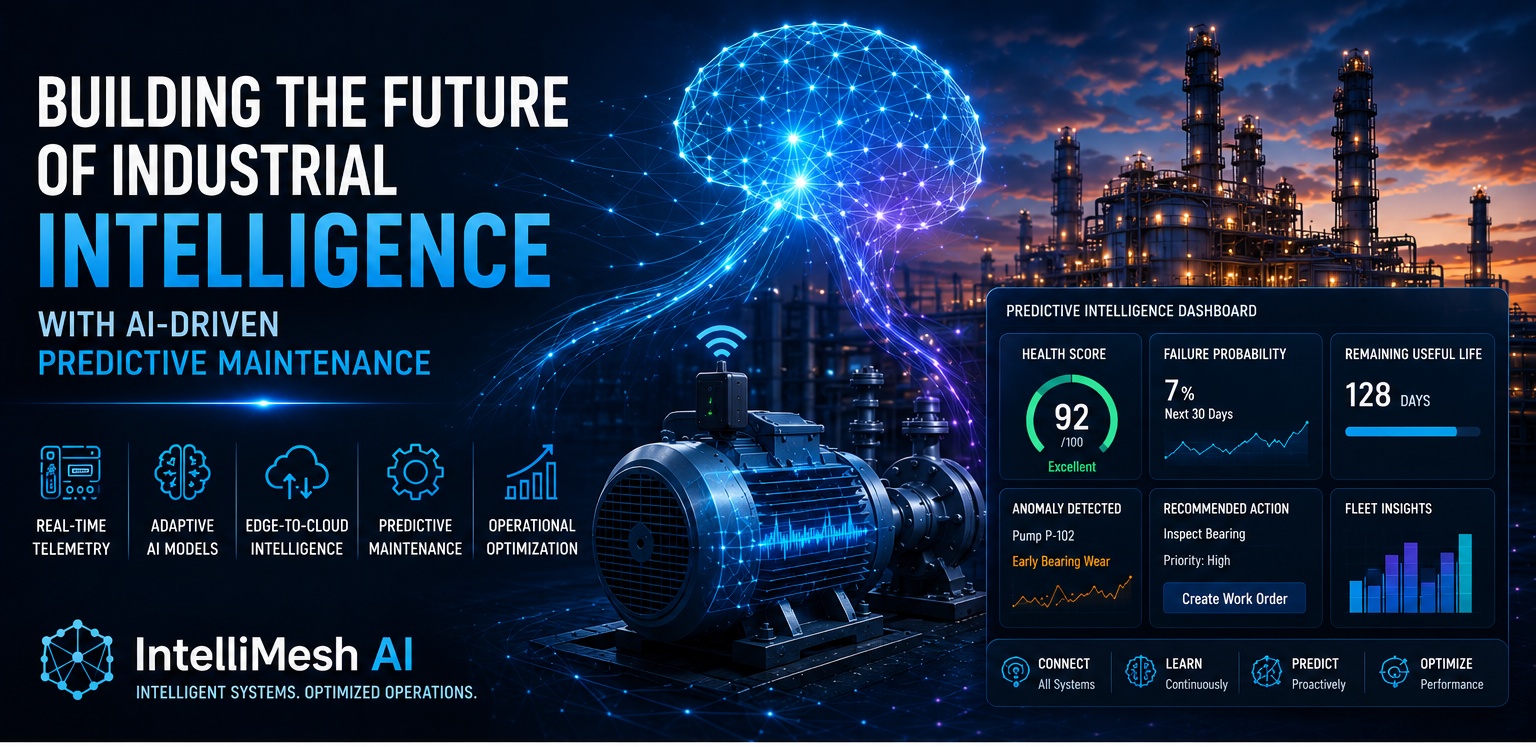
Industrial systems generate more data than ever—yet most manufacturers still struggle to turn that data into actionable intelligence.
Industrial systems are generating more operational data than ever before — yet most manufacturers still struggle to transform that data into actionable intelligence.
Traditional maintenance strategies remain largely reactive:
The result is unnecessary downtime, excess maintenance costs, inefficient asset utilization, and fragmented operational intelligence.
At IntelliMesh AI, we are building a new framework designed to bridge operational technology (OT), industrial AI, and cloud-scale intelligence into a unified predictive ecosystem. Our platform combines real-time industrial telemetry, adaptive machine learning, edge-to-cloud data orchestration, digital operational context, and predictive maintenance intelligence to create a continuously learning industrial optimization framework.
Learn more at How It Works.
Skim the framework overview first—or expand Core Components below for the five layers that make adaptive industrial intelligence work.
Jump to: The problem with traditional PM · The IntelliMesh AI framework · Core components deep dives · Explainable industrial AI · Why this matters · The future of industrial intelligence
Most predictive maintenance systems today stop at anomaly detection.
They identify vibration thresholds, temperature spikes, pressure deviations, and operational outliers. But modern industrial environments require more than isolated alerts.
The real challenge is contextual intelligence:
Research from IBM notes that AI-powered predictive maintenance represents a major shift from static scheduled maintenance toward real-time, data-driven operational intelligence. Similarly, Oracle describes predictive maintenance as a convergence of IoT sensor networks, machine learning, anomaly detection, and operational forecasting—designed to proactively predict equipment failures before downtime occurs.
The next generation of industrial AI requires something larger: an intelligent operational mesh.
The IntelliMesh AI architecture was designed around a core principle:
Industrial systems should continuously learn from themselves.
Rather than treating predictive maintenance as a standalone analytics module, IntelliMesh AI creates an adaptive intelligence layer that connects PLCs, SCADA systems, historians, IIoT sensors, edge devices, cloud infrastructure, and operational workflows into a unified learning environment.
Optional detail on the five layers that turn raw OT telemetry into continuously improving operational intelligence—expand each component below.
The framework continuously ingests telemetry from:
This enables high-frequency operational visibility, event correlation, multi-system state awareness, and live operational baselining.
The architecture supports both edge processing and cloud-native streaming pipelines for scalable industrial deployments.
One of the major limitations of many predictive maintenance systems is the absence of operational context.
A temperature spike alone may not indicate a problem. But temperature increase combined with increased vibration, reduced throughput, elevated current draw, and changing environmental conditions may indicate emerging degradation.
IntelliMesh AI models these relationships dynamically. This allows the framework to move beyond threshold monitoring into contextual reasoning, system-state awareness, and operational dependency mapping.
This approach aligns closely with emerging Industry 5.0 AIoT frameworks that combine AI and industrial IoT into intelligent adaptive maintenance ecosystems.
Traditional industrial AI systems often suffer from model drift: operational conditions change, equipment ages, process inputs evolve, and production environments fluctuate. Static models eventually become inaccurate.
The IntelliMesh AI framework addresses this through adaptive learning pipelines capable of:
This creates a living operational intelligence system instead of a static predictive engine. Research in predictive maintenance increasingly emphasizes adaptive AI, self-learning architectures, real-time inference, reinforcement learning, and edge intelligence as the future of industrial reliability systems.
Industrial environments require low-latency decision making. Certain analytics must occur on-machine, on-site, or near the process edge—while enterprise optimization requires cloud aggregation, fleet-wide learning, long-term trend analysis, and enterprise-scale optimization.
The IntelliMesh AI framework enables both. Its architecture supports edge inference, cloud retraining, distributed telemetry, centralized model governance, and scalable AI deployment pipelines.
This creates a hybrid intelligence model optimized for modern industrial operations.
Predictive maintenance alone is not enough. The next evolution of industrial AI is operational optimization.
IntelliMesh AI expands beyond failure prediction into performance optimization, energy efficiency analysis, process optimization, operational tuning, lifecycle intelligence, and asset utilization forecasting.
This allows organizations to optimize uptime, efficiency, reliability, throughput, maintenance scheduling, and operational cost simultaneously.
One of the growing challenges in industrial AI adoption is trust. Operators and engineers need transparency, explainability, and operational confidence—not just black-box predictions.
Emerging research into Explainable Predictive Maintenance (XPM) highlights the importance of interpretable AI systems for operational adoption and long-term trust.
The IntelliMesh AI framework is designed with operational explainability in mind:
This helps engineering teams understand why a prediction occurred, what operational factors contributed, and how maintenance decisions should be prioritized.
Industrial organizations are entering a new operational era. The convergence of AI, IIoT, edge computing, industrial telemetry, and cloud infrastructure is transforming how industrial systems are managed.
Modern predictive maintenance is no longer simply about preventing failures. It is about creating intelligent operations, adaptive systems, self-learning infrastructure, and resilient manufacturing ecosystems.
Industry research increasingly points toward AIoT-enabled maintenance architectures as foundational to Industry 5.0 transformation strategies.
At IntelliMesh AI, we believe the future industrial stack will be adaptive, connected, explainable, autonomous, and continuously learning.
Our mission is to help organizations transition from reactive maintenance, fragmented telemetry, and disconnected operational systems toward intelligent operational ecosystems, predictive optimization, and AI-driven industrial resilience.
Explore the IntelliMesh AI framework: How It Works