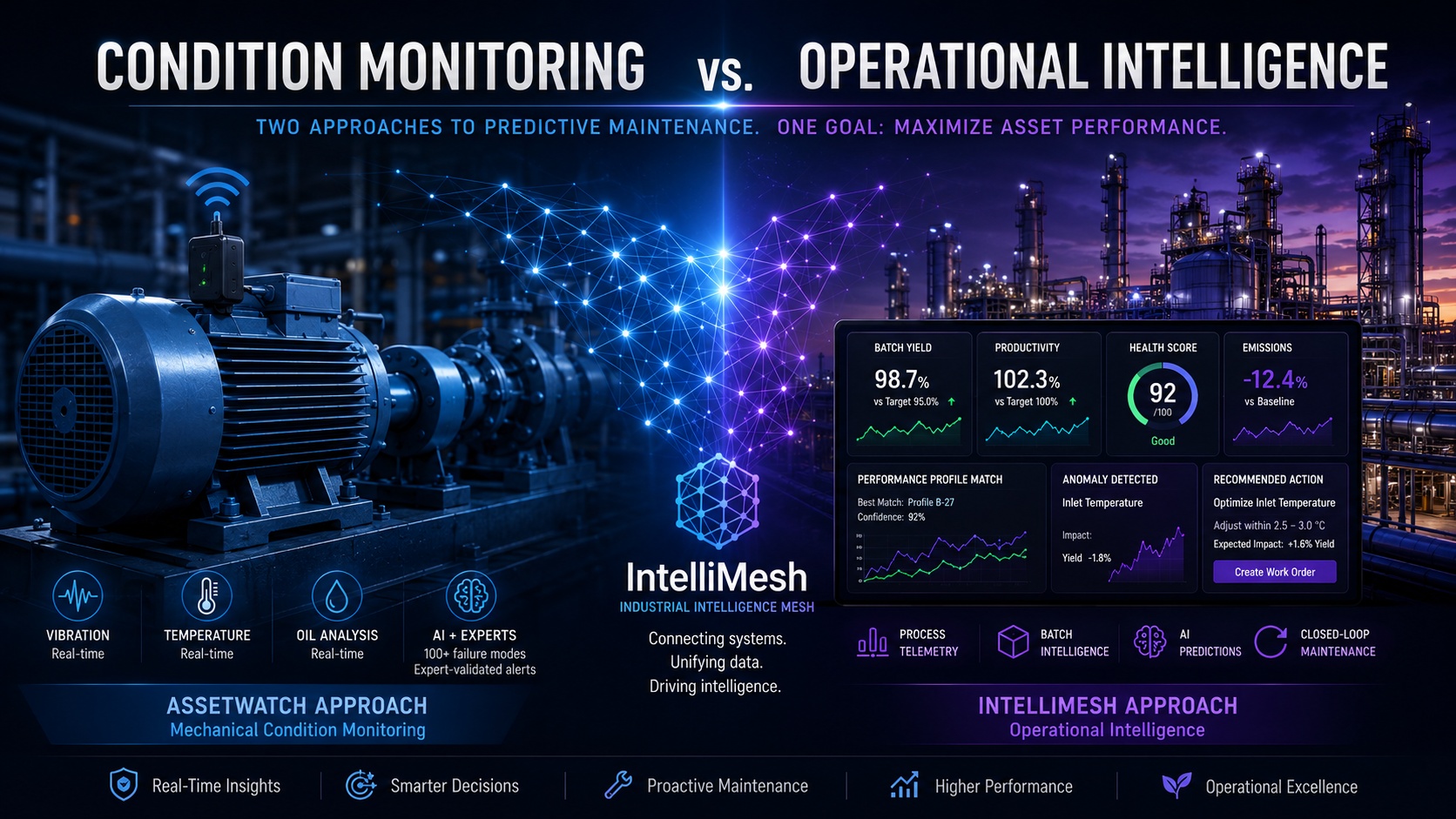
Not all predictive maintenance is the same. Compare mechanical condition monitoring (AssetWatch) with self-learning process intelligence (IntelliMeshAI)—and when to use both.
Two Valid Definitions of Predictive Maintenance
In our first Insights article, we argued that the gap in industrial AI is not anomaly detection alone—it is contextual, adaptive, explainable operational intelligence.
That framing helps when comparing two strong but different approaches to “predictive maintenance”:
- Mechanical condition-based monitoring (CBM) — continuous vibration, temperature, and lubrication analysis on rotating equipment, often delivered as a managed service with expert validation.
- Operational intelligence mesh — process telemetry, batch prediction, device productivity, performance profiles, and maintenance workflows that close the loop from alert to resolution.
AssetWatch represents the first category at industrial scale. IntelliMeshAI targets the second: extending predictive maintenance from “find the failing bearing” to “explain why yield, efficiency, or emissions shifted—and what to do next.”
Neither replaces the other in every plant. Understanding the difference helps teams choose the right tool—or combine both.
Skim the comparison and when to use which sections first—or expand product deep dives below for AssetWatch and IntelliMeshAI detail.
On this page
Jump to: Side-by-side comparison · When to use which · Product deep dives · From alerts to operational intelligence
Side-by-Side Comparison
The comparison below summarizes how AssetWatch (mechanical CBM) and IntelliMeshAI (process operational intelligence) answer different questions. Use it as a map—not a scorecard. Many mature plants combine both: vibration and oil analysis on critical drives, plus process intelligence where batch drift affects profitability.
What fails first?
- AssetWatch: Bearing wear, misalignment, lubrication issues on rotating assets
- IntelliMeshAI: Process drift, threshold exceedance, component failure profiles affecting batch yield and productivity
What is “health”?
- AssetWatch: Vibration, oil, and temperature condition
- IntelliMeshAI: Component sensor health and device productivity and batch anomaly score
Is AI autonomous?
- AssetWatch: AI detects; certified analysts prescribe
- IntelliMeshAI: AI detects and scores; your workflow (Jira/CMMS) closes the loop; resolution hooks drive sim and production behavior
Does it learn on your data?
- AssetWatch: Fleet-trained models + site signals; central refinement
- IntelliMeshAI: Per-device / per-feedstock models retrained from your batch history on each prediction cycle
Time to value
- AssetWatch: Days (they install sensors)
- IntelliMeshAI: Depends on OT path—Ignition/Injector can attach to existing tags without a parallel sensor bundle
Best for
- AssetWatch: Plants with critical rotating assets wanting managed CME service
- IntelliMeshAI: Plants optimizing production outcomes with OT-native integration and traceable maintenance loops
When to Use Which—or Both
Choose AssetWatch-style CBM when:
- Your highest-value reliability risk is rotating mechanical equipment
- You want turnkey sensors plus 24/7 expert-validated monitoring
- Minimal internal data-science or condition-monitoring staffing is a priority
Choose IntelliMeshAI when:
- Production outcomes—yield, throughput, energy, emissions—matter as much as mechanical uptime
- You already run Ignition, historians, or similar OT stacks and want to extend them
- You need adaptive batch models, productivity correlation, profile signatures, and closed-loop maintenance KPIs
Use both on large sites:
- Vibration and oil analysis on critical drives, compressors, and pumps
- Process intelligence mesh on reactors, lines, and batch operations where drift affects profitability
The future factory is not choosing between mechanical reliability and process optimization—it is connecting both into a coherent operational picture.
Product deep dives (deep dives)
Respectful detail on each platform—expand AssetWatch or IntelliMeshAI below.
AssetWatch: Real-Time Mechanical Health, Human-in-the-Loop AI
AssetWatch is an end-to-end condition monitoring service. Their model combines wireless sensors, cloud analytics, and certified Condition Monitoring Engineers (CMEs) who validate alerts before customers receive prescriptive guidance.
From AssetWatch’s platform overview, software page, and AI page, the product centers on:
- Primary data: Wireless vibration, temperature, and oil analysis (Vero® sensors)
- Asset focus: Rotating equipment—motors, gearboxes, pumps, fans, blowers, compressors
- Real-time health: Continuous monitoring, live trends, and prioritized alerts
- AI role: Detect 100+ failure modes, score and rank anomalies, filter noise, and summarize facility health
- Human role: Certified CMEs validate alerts and contribute to model refinement before customers act
- Prescriptive maintenance: Work instructions and maintenance guidance—primarily human-authored after expert review
- Integration: CMMS connections (e.g. SAP), mobile app; marketed as minimal IT integration for their sensor stack
- Business model: Subscription SaaS—sensors, installation, 24/7 monitoring, unlimited users included
Does AssetWatch “self-learn”?
AssetWatch markets AI that evolves with more data. Their R&D team continuously refines models trained on a large fleet corpus (they cite 400M+ machine hours and 87B+ metrics). CMEs also validate alerts and help train AI models.
That is fleet-scale machine learning improvement—central model refinement across many sites—not dynamic retraining of a new regression model on every batch prediction request at an individual plant.
Does AssetWatch deliver real-time device health?
Yes—for mechanical condition. Vibration, temperature, and oil trends give rotating-asset health in near real time.
It is not real-time process or batch optimization: predicted yields, productivity vs. expected output, emissions correlation, or closed-loop work-order resolution tied to operational performance profiles.
Where AssetWatch excels
- Low operational lift for teams that want managed expert monitoring
- Strong ROI narrative for critical rotating assets
- Expert-validated alerts reduce false-alarm fatigue
- Turnkey subscription—sensors, install, cloud, and analysts in one package
For plants whose primary reliability risk is mechanical degradation on pumps, motors, and drives, this is a proven category.
IntelliMeshAI: Self-Learning at the Production Layer
IntelliMeshAI is an industrial intelligence mesh: telemetry ingestion, hourly component health, device productivity, batch anomaly detection, performance profile matching, and maintenance workflow integration.
Rather than replacing SCADA with a parallel sensor silo, IntelliMeshAI connects existing plant systems—including Ignition and the AWS Injector by Inductive Automation—into a streaming pipeline (Kinesis → Lambda → RDS/API) that preserves OT investments while adding adaptive intelligence.
What makes the learning architecture different
IntelliMeshAI’s patent-pending approach (see our How It Works page and design documentation) emphasizes:
- Dynamic per-request regression training on historical batches—not a single static model frozen at deployment
- Prediction-based anomaly baselines derived from expected batch outputs, not fixed thresholds alone
- Multi-level health: component hourly metrics, device productivity trends, batch anomaly scores, and performance failure profiles
- Closed-loop maintenance: alerts flow into operational workflows (e.g. Jira Service Management); resolution types feed back into simulation and production behavior
In our A5 simulation campaign, we measured this loop operationally: 21 closed-loop maintenance successes, 6/6 performance profile signature matches, and 100% directional agreement on the Jira cohort for process-trend validation—evidence that the mesh connects detection to resolution with traceable KPIs.
Real-time health in IntelliMeshAI
IntelliMeshAI delivers real-time and near-real-time intelligence at the process layer:
- Hourly component health (device_component_hourly)
- Live threshold evaluation and alert generation
- Productivity and batch-output comparison against predicted baselines
- Profile-aware anomaly classification tied to explainable failure modes
This is complementary to vibration CBM: it answers “why did this batch underperform?” and “which component profile does this drift match?”—not only “is this bearing failing?”
Where IntelliMeshAI excels
- Process manufacturers optimizing yield, energy, efficiency, and emissions
- Teams with Ignition/SCADA/historian investments who want intelligence on existing tags
- Organizations that need explainable, profile-based anomaly reasoning and closed-loop maintenance KPIs
- Adaptive models that retrain from each device’s own batch and sensor history as new data arrives
From Alerts to Operational Intelligence
AssetWatch delivers strong real-time mechanical health monitoring by combining wireless vibration and temperature sensors with AI anomaly detection and certified analyst validation—a managed service model that turns condition data into prescriptive maintenance guidance without heavy IT integration.
IntelliMeshAI takes a complementary path: it connects existing plant systems—including Ignition and the AWS Injector by Inductive Automation—into a self-learning operational mesh that trains batch prediction models from your production history, scores device productivity alongside component health, matches performance failure profiles, and closes the loop from alert through maintenance resolution with traceable KPIs.
AssetWatch’s AI learns across a large fleet corpus and improves with central model refinement. IntelliMeshAI’s models adapt continuously to each device’s batch and sensor history at inference time.
For teams optimizing process outcomes—not only rotating-equipment vibration—IntelliMeshAI extends predictive maintenance from isolated alerts to explainable, adaptive operational intelligence.
Learn More
References
- AssetWatch — Predictive Maintenance Platform
https://www.assetwatch.com/
- AssetWatch — Software
https://www.assetwatch.com/software
- AssetWatch — Predictive Maintenance AI
https://www.assetwatch.com/predictive-maintenance-ai
- IntelliMesh Systems — How It Works
https://www.intellimeshai.com/howitworks
- IntelliMeshAI Blog — Building the Future of Industrial Intelligence with AI-Driven Predictive Maintenance
https://www.intellimeshai.com/blog-posts/building-the-future-of-industrial-intelligence-with-ai-driven-predictive-maintenance
- IBM — The Role of AI in Predictive Maintenance
https://www.ibm.com/think/insights/ai-in-predictive-maintenance
- Oracle — Using AI in Predictive Maintenance
https://www.oracle.com/scm/ai-predictive-maintenance/