Craft and production breweries now have strong fermentation sensors, brewery ERPs, and facility analytics—but most stop at alerts and batch logs. Compare Sennos, AccuBrew, BrewMonitor, Ekos, Beer30, PLAATO, and facility analytics vendors with IntelliMeshAI’s profile signatures, batch prediction, risk cards, and closed-loop maintenance workflows.
In our first Insights article, we argued that the gap in industrial AI is not anomaly detection alone—it is contextual, adaptive, explainable operational intelligence.
That framing helps when comparing two strong but different approaches to “predictive maintenance” in a brewery:
· Fermentation and equipment condition monitoring — continuous tank data (specific gravity, temperature, pressure, dissolved oxygen, pH) plus equipment signals (glycol, agitators, chillers, packaging lines). Alerts fire when curves or thresholds drift. The question answered is: Something is wrong with this batch or asset—look now.
· Operational intelligence mesh — process telemetry from existing OT, batch prediction, hourly component health and device productivity, named performance profiles, risk cards, and maintenance workflows that close the loop from alert to resolution. The question answered is: Which failure mode is rising? Did maintenance actually fix it? What did we lose in yield?
Sennos, AccuBrew, and BrewMonitor represent the first category at fermentation scale. Ekos and Beer30 organize production of record. Facility analytics vendors such as PLAATO Insights extend visibility across PLCs, packaging, and utilities. IntelliMeshAI targets the operational-intelligence layer: extending predictive maintenance from “this curve looks off” to “this matches fermentation overheating or chiller capacity stress—here is the maintenance path and the recovery KPIs.”
In our comparison with mechanical condition monitoring, we showed why vibration and oil analysis on pumps and motors complements—but does not replace—process-layer intelligence. In our EU pyrolysis piece on failure-mode risk cards, we described how named profiles turn process physics into operator-ready early warning. This article applies the same comparison logic to brewing: respectful vendor treatment first, then where IntelliMeshAI fits in a stack many breweries already own.
Most brewery software answers “What is the tank doing?” or “Where is my inventory?” Production breweries scaling past a dozen fermenters also need “Which failure mode is rising—and did maintenance actually fix it?” Tank sensors and brewery ERP are necessary infrastructure. They rarely close the loop from process risk → maintenance action → verified recovery across the whole site.
Neither category replaces the other on every floor. Understanding the difference helps teams choose the right tool—or combine several without building parallel data silos.
Skim the comparison and IntelliMeshAI sections first if you already know the vendor landscape—or expand vendor deep dives at the end for Sennos, Ekos, PLAATO, and similar platforms.
Jump to: Side-by-side comparison · IntelliMeshAI brewery intelligence · When to combine · Vendor deep dives · From Tank Alerts to Operational Intelligence
The comparison below summarizes how four platform layers answer different questions. Use it as a map—not a scorecard. Most production breweries combine two or more layers; operational intelligence extends the stack when named failure modes, batch yield prediction, and maintenance closure matter alongside tank curves and ERP schedules.
· Tank sensing: How is this ferment progressing?
· Brewery ERP: Where is my production state?
· Facility analytics: Where are bottlenecks and equipment risks?
· IntelliMeshAI Brewery: Which failure mode is rising—and did maintenance work?
· Tank sensing: In-tank probes (SG, DO, pH, pressure, temp)
· Brewery ERP: Batch records, inventory, schedules, compliance
· Facility analytics: PLCs, packaging, utilities, throughput signals
· IntelliMeshAI Brewery: OT telemetry + batch-close KPIs + hourly health
· Tank sensing: Fermentation curve, completion forecast
· Brewery ERP: On-schedule, compliant production records
· Facility analytics: Equipment and facility KPIs
· IntelliMeshAI Brewery: Component health + productivity + profile signature
· Tank sensing: Anomaly / alert on curve drift
· Brewery ERP: Operational exceptions (schedule, QC)
· Facility analytics: Generic PM alert / bottleneck flag
· IntelliMeshAI Brewery: Named profiles (overheating, chiller, yeast/yield)
· Tank sensing: Indirect (completion timing)
· Brewery ERP: Historical batch compare / reporting
· Facility analytics: Limited cross-batch process modeling
· IntelliMeshAI Brewery: Dynamic regression on batch outputs
· Tank sensing: Notify brewer / cellar team
· Brewery ERP: Work orders and tasks (manual workflow)
· Facility analytics: CMMS integration (varies by vendor)
· IntelliMeshAI Brewery: Jira/ITSM → mitigation → recovery KPIs
· Tank sensing: Fleet fermentation database / batch compare
· Brewery ERP: Reporting and dashboards
· Facility analytics: Site or fleet baselines
· IntelliMeshAI Brewery: Per-device batch history + profile signatures
· Tank sensing: Cellar QC, stuck ferment, completion planning
· Brewery ERP: Ops coordination, TTB, brew-to-package
· Facility analytics: Multi-line throughput and utility PM
· IntelliMeshAI Brewery: Multi-tank sites optimizing yield, uptime, and audit trail
· Tank sensing: ERP, SCADA
· Brewery ERP: Tank sensors, accounting
· Facility analytics: SCADA, MES
· IntelliMeshAI Brewery: SCADA / historians, ERP, optional tank sensors
· Tank sensing: Stuck ferment, abnormal SG/DO curve, completion drift
· Brewery ERP: Schedule slip, inventory mismatch, compliance gap—not mechanical or thermal failure modes
· Facility analytics: Packaging jam, line downtime, utility or glycol stress patterns
· IntelliMeshAI: Process drift matching named profiles—thermal runaway, chiller capacity loss, yeast/yield degradation—affecting batch-close outcomes
· Tank sensing: Near-real-time fermenter curves
· Brewery ERP: Production state updates as teams enter or integrate data
· Facility analytics: PLC-driven equipment trends and alerts
· IntelliMeshAI: Hourly component health and productivity vs. predicted batch baselines, live threshold evaluation, profile-aware classification
· Tank sensing: Fleet-scale fermentation models plus site batch history (vendor-dependent)
· Brewery ERP: Reporting on your records—not adaptive per-batch regression at inference
· Facility analytics: Site baselines and anomaly rules; depth varies by vendor
· IntelliMeshAI: Per-device models retrained from your batch history and OT telemetry on each prediction cycle
Most production breweries already run tank probes, ERP, facility dashboards, and SCADA. IntelliMeshAI occupies a different layer—the operational intelligence mesh that learns from OT telemetry messages and batch-close outcomes, matches named failure modes, surfaces risk cards operators can act on, and closes maintenance loops through ITSM workflows.
Rather than replacing cellar probes or production software with a parallel sensor silo, IntelliMeshAI ingests the telemetry streams breweries already generate—temperatures, flows, energy, yields, and batch KPIs—often via streaming connectors such as Ignition with the AWS Injector by Inductive Automation, but not limited to that path. The mesh adds adaptive batch models, hourly component health and device productivity, performance profile signatures, and Jira-integrated maintenance resolution on top of existing OT investments.
IntelliMeshAI is not an in-tank specific-gravity probe replacement. Sennos, AccuBrew, and BrewMonitor remain best-in-class inside the fermenter. Ekos and Beer30 remain the operations hub. IntelliMesh extends the stack when thermal, cooling, and yield failure modes must be explained, scored, and closed across the site.
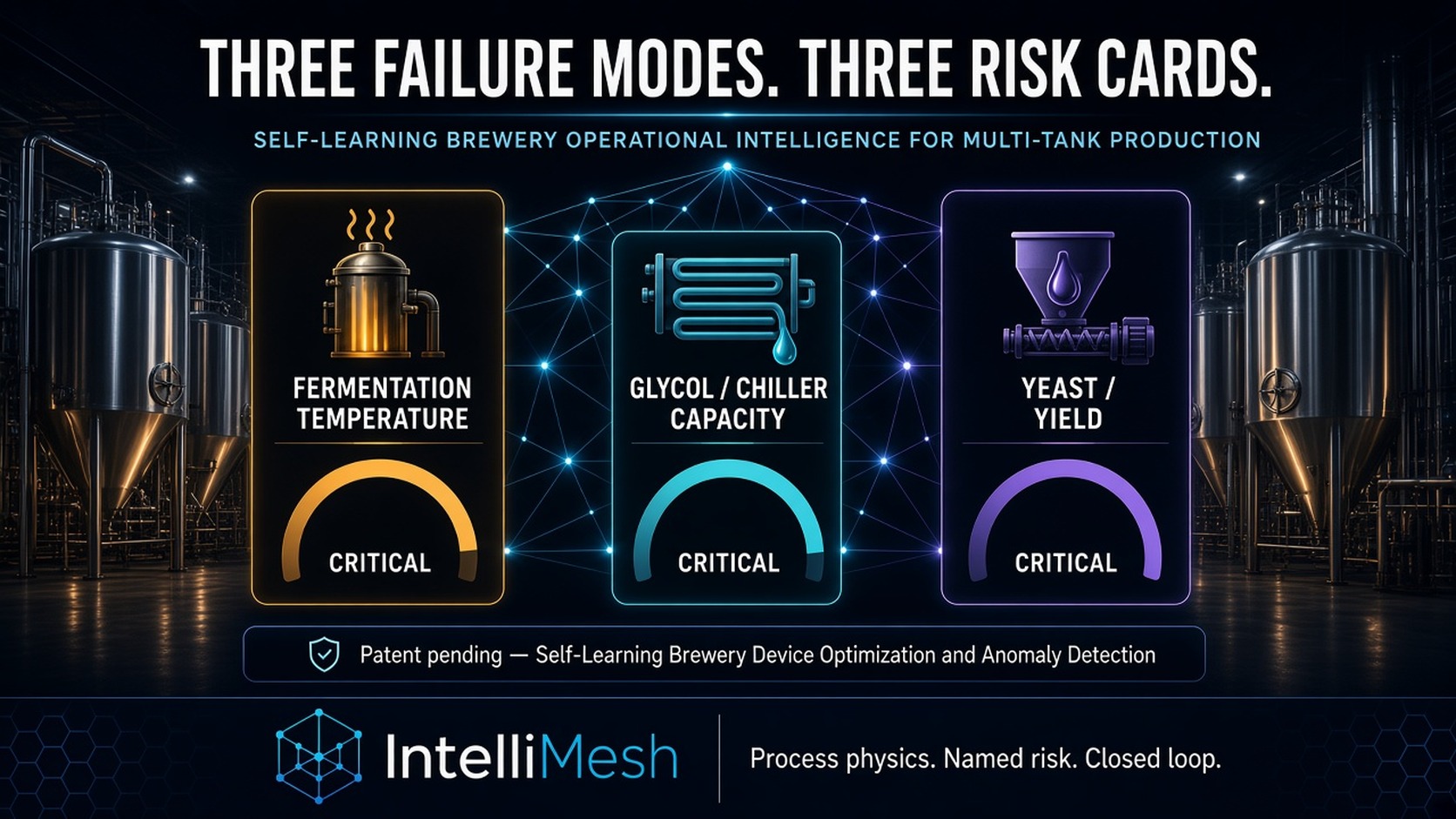
Cellar and production teams do not think in abstract anomaly scores. They think in failure modes that waste batches, burn cooling capacity, or force emergency transfers. IntelliMeshAI brewery intelligence focuses on three recurring patterns—and delivers each as an operator-facing risk card with rising criticality and explainable leading signals.
Process / ops: A fermenter running hot stresses yeast, accelerates off-flavors, and can force unplanned cooling interventions. The hard question on the floor is not only “temperature is high”—it is whether the tank is running hot as a failure mode or simply finishing on a warm profile.
Software outcome: The Fermentation Temperature Risk card accumulates evidence from tank, jacket, and glycol telemetry alongside cooling energy—surfacing rising criticality with named drivers before yield and quality pay the price at batch close.
Process / ops: When the chiller loop cannot keep up, multiple tanks drift together. Glycol reservoir temperature climbs, cooling energy spikes, and cellar teams chase symptoms tank-by-tank instead of fixing the utility root cause.
Software outcome: The Glycol / Chiller Capacity Risk card correlates reservoir conditions, cooling energy, and tank following behavior—giving maintenance a facility-level early warning, not only per-tank alarms.
Process / ops: Final gravity misses target, fermentation runs long, and packaged yield falls short of plan—“stuck ferment” and yield degradation show up in lab results and batch-close KPIs, often after the window for gentle correction has passed.
Software outcome: The Yeast / Yield Risk card compares fermentation duration, alcohol by volume, and yield against predicted batch baselines—flagging yeast-health degradation as a named mode while there is still time to intervene.
· Fermentation temperature: Named thermal runaway risk with explainable drivers—not only a high-temperature alarm
· Glycol / chiller capacity: Utility-level cooling stress visible before multiple tanks diverge
· Yeast / yield: Productivity drift scored against predicted batch outcomes—not only a flat SG curve alert
A fourth baseline profile—top efficiency—anchors normal production weeks so risk cards rise relative to healthy operation, not against generic thresholds alone.
Production leaders should ask what “AI for brewing” actually computes. In plain language, IntelliMeshAI:
1. Ingests OT telemetry messages into hourly component health and device productivity—fermenter thermal systems, cooling loops, and batch-output components scored against predicted baselines rooted in how the brewery actually runs.
2. Scores completed batches for yield, final gravity, alcohol by volume, and energy versus predicted outcomes from recipe and process conditions. Predictions improve as batch history grows—the self-learning loop in our patent-pending methods.
3. Recognizes named process behaviors—fermentation overheating, chiller capacity stress, yeast and yield degradation, and nominal top-efficiency weeks—so the system speaks cellar and maintenance language, not only statistical outliers.
4. Matches performance profile signatures over batch history, distinguishing sustained failure-mode drift from short-lived dashboard noise.
5. Surfaces rising failure-mode risk in the operator experience as risk cards with criticality and drivers—not a black-box percentage alone.
6. Closes the maintenance loop through Jira and ITSM workflows—alert, mitigation, resolution, and recovery KPIs—so health history reflects “fixed,” not only “alarmed.”
See How It Works for the architecture overview and our operational intelligence platforms comparison for where this layer sits relative to SCADA analytics and mechanical condition monitoring.
Choose tank sensing (Sennos, AccuBrew, BrewMonitor) when:
· Cellar consistency and stuck-ferment detection are the primary pain
· Completion timing and SG curve visibility drive packaging decisions
· You want low-lift probe analytics without extending SCADA
Choose brewery ERP (Ekos, Beer30) when:
· Scheduling, TTB compliance, inventory, and brew-to-package coordination are the bottleneck
· Production of record—not adaptive anomaly engines—is the core need
Choose facility analytics (PLAATO Insights and similar) when:
· Packaging, glycol, and utility predictive maintenance across lines matter most
· PLC-wide bottleneck detection is the immediate goal
Choose IntelliMeshAI when:
· Multiple failure modes span thermal, cooling, and yield—not only curve drift inside one tank
· SCADA and historians already publish the telemetry streams you need
· Leadership requires explainable profiles, risk cards, and maintenance closure with recovery KPIs
· You are scaling past “one dashboard per vendor silo” and need a mesh that learns from your batch history
Use a combined stack on production sites:
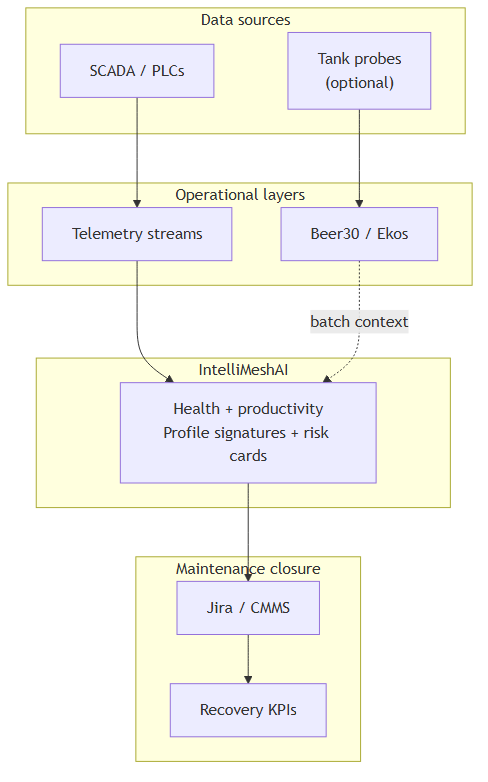
Combined brewery stack: SCADA telemetry and optional tank probes feed IntelliMeshAI; maintenance closure flows through Jira/CMMS to recovery KPIs.
Tank probes catch curve problems early. ERP keeps production lawful and coordinated. Facility analytics widens the lens to packaging and utilities. Operational intelligence ties named failure modes to maintenance outcomes and batch-close economics—yield, energy, and packaging windows.
Optional detail for readers evaluating specific vendors—expand each layer or product below. (Collapsible on the live site when blog-post-collapsible.js is enabled on the Blog Posts Template.)
The first layer of brewery predictive maintenance lives inside the tank. Vendors here sell probes, cloud analytics, and alerts tuned to fermentation curves—specific gravity, temperature, pressure, dissolved oxygen, and related signals. Their value proposition is clear: reduce manual sampling, catch stuck ferments early, and forecast completion so cellar and packaging can plan ahead.
These platforms excel at batch curve intelligence. They are not designed to replace site-wide OT historians, brewery ERP, or closed-loop maintenance workflows that tie alerts to Jira, CMMS, and post-fix recovery KPIs. That distinction matters when a head brewer asks whether a tank is running hot—or merely finishing late on a healthy curve.
Sennos combines the SennosM3 in-tank sensor array, the Sennoslink operator interface, and SennosIQ analytics. From Sennos’s platform overview and SennosIQ product pages, the stack centers on:
· Primary data: High-frequency fermentation and environmental readings from an in-tank sensor array
· Real-time visibility: Live fermentation trends and anomaly flags in Sennoslink
· AI role: SennosIQ forecasts batch completion, surfaces anomalies, and benchmarks batches against fleet history—Sennos markets one of the largest fermentation databases in the industry
· Human role: Brewers interpret alerts and adjust cellar practice; customer stories cite concrete savings on cooling and solenoid maintenance
· Integration: Sennoslink as the primary UI; positioning spans brewing and adjacent fermentation industries including biofuels
· Business model: Sensor hardware plus cloud analytics subscription
· Deep fermentation-domain focus—completion timing, curve anomalies, and cross-batch benchmarking
· Strong narrative for breweries that want in-tank intelligence without building a data-science team
· Fleet-scale learning improves forecasts as more batches accumulate in the Sennos corpus
Sennos answers “how is this ferment progressing?” exceptionally well. It does not, in its product story, deliver site-wide component health and productivity meshes, named failure-mode profiles matched across brewhouse and cellar OT telemetry, or Jira closed-loop maintenance with recovery KPIs after a chiller or packaging fix. For multi-tank sites where glycol, yield at batch close, and maintenance traceability matter as much as the SG curve, that gap is where operational intelligence layers complement tank sensing.
AccuBrew (Gulf Photonics) targets craft and production breweries that want peace-of-mind specific gravity monitoring without a full multi-parameter probe stack. From AccuBrew’s product materials and industry reviews:
· Primary data: Optical specific gravity, clarity, and temperature through a 1.5” tri-clamp probe—designed for CIP compatibility
· Sampling cadence: Multiple readings per day (AccuBrew cites on the order of 96 readings daily), replacing much manual gravity logging
· AI role: AccuCrew chat and account-level analytics for batch comparison and trend questions (marketing emphasis on brewer-friendly AI assistance)
· Human role: Brewers receive alerts when curves diverge; AccuBrew emphasizes simplicity over instrumentation complexity
· Integration: AccuBrew cloud and mobile experience; lighter OT integration than a full SCADA extension
· Business model: Per-tank sensor subscription oriented to craft scale
· Low operational lift for breweries upgrading from manual gravity checks
· CIP-ready hardware suited to cellar hygiene requirements
· Clear ROI story for stuck-ferment detection and remote visibility when the team is not on the floor
AccuBrew is intentionally single-tank in scope. It does not correlate glycol reservoir stress, chiller energy, packaging bottlenecks, or batch-close yield bands across the facility—and it does not close maintenance workflows when a cooling loop degrades. That is a feature of its simplicity, not a flaw; it defines where AccuBrew stops and facility-wide operational intelligence begins.
BrewMonitor from Precision Fermentation is a multi-parameter fermentation monitor—dissolved oxygen, pH, gravity, pressure, conductivity, and ambient and fluid temperature—in a form factor brewers mount on standard tri-clamp ports. From Precision Fermentation’s product and integration materials:
· Primary data: Six-parameter fermentation stream designed to replace much manual lab sampling
· Real-time visibility: Live curves and alerts when parameters drift from expected behavior
· Integration: Documented integration with Beer30 (The 5th Ingredient)—fermentation data flows into brewery production software alongside tank scheduling and batch records
· Human role: Cellar and lab teams act on alerts; production software becomes the operational hub
· Business model: Hardware plus cloud analytics; positioned from craft through production scale
· Richer parameter set than gravity-only monitoring—especially valuable for lager programs, stress-sensitive strains, and QA-driven brands
· MES bridge through Beer30 and similar ops platforms—fermentation telemetry meets production scheduling in one UI
· Credible replacement for manual DO, pH, and gravity sampling on critical batches
BrewMonitor remains a fermentation island in architectural terms: excellent inside the tank, with equipment predictive maintenance and batch-close yield analysis still downstream in ERP, facility analytics, or operational intelligence layers. When a chiller loses capacity or yeast health degrades across several tanks, the leading signals often live in glycol, energy, and productivity tags—not only in the fermenter probe stream.
Beyond dedicated fermentation SaaS, breweries also deploy inline process instrumentation—for example Endress+Hauser density and turbidity probes or Mettler Toledo ISM intelligent sensor management for probe diagnostics and remaining lifetime. These tools strengthen instrument health and inline quality measurement. They are not substitutes for named failure-mode intelligence that correlates brewhouse, cellar, utilities, and batch-close outcomes across plant telemetry from SCADA and historians.
In-tank fermentation intelligence—whether Sennos’s fleet AI, AccuBrew’s optical simplicity, or BrewMonitor’s multi-parameter MES bridge—wins inside the fermenter. It catches curve problems early and forecasts completion for cellar planning.
It does not, on its own, deliver site-level performance profile signatures, batch yield prediction against adaptive baselines, explainable risk cards for overheating or chiller stress, or closed-loop maintenance from alert through Jira resolution. The next layers—brewery ERP, facility analytics, and OT foundations—address different questions. We take those up in the sections that follow.
The second layer is production of record—software breweries run even when they are not thinking about “AI.” These platforms schedule tanks, track inventory, support TTB and compliance reporting, and give production managers a single view of brew-to-package status. They are essential. They are also a different category from predictive maintenance in the operational-intelligence sense.
Brewery ERP and MES tools organize data: recipes, tank boards, lab results, yeast management, cost of goods, and fermentation history—often populated manually, sometimes fed by in-tank probes such as BrewMonitor. Their alerts are typically operational (“tank overdue,” “inventory low,” “QC out of spec”) rather than profile-classified failure modes tied to adaptive batch baselines and maintenance closure KPIs.
Ekos is widely positioned as a leading craft beverage ERP—production scheduling, inventory, sales, accounting, and regulatory reporting in one platform. From Ekos’s product materials and market presence:
· Primary data: Batch records, tank schedules, inventory movements, fermentation logs, TTB reporting, and production dashboards
· Operational role: Brew-to-package coordination—the system of record for what was brewed, where it sits, and what shipped
· Fermentation visibility: Graphical fermentation history and production tracking; data may be entered manually or integrated from external sensor feeds depending on customer setup
· Human role: Production managers, cellar staff, and finance teams work from shared operational truth
· Integration: Broad brewery operations stack—accounting, inventory, and production modules designed to replace spreadsheets
· Business model: SaaS subscription scaled from craft through regional production
· Compliance and operations of record—TTB, inventory accuracy, and production scheduling for growing breweries
· Unified view of production state without forcing a separate sensor vendor choice
· Mature category for teams whose primary pain is coordination and reporting, not adaptive anomaly engines
Ekos is not marketed as a closed-loop predictive maintenance mesh. It does not, in its core product story, deliver hourly component health scored against predicted batch outputs, named performance profiles such as fermentation overheating or chiller capacity stress, or Jira-integrated maintenance loops with post-fix recovery KPIs. When fermentation curves arrive via a third-party probe, Ekos displays and organizes them—it does not replace an operational intelligence layer that learns from batch history and OT telemetry streams and closes maintenance workflows.
Beer30 from The 5th Ingredient targets production management from brewhouse through packaging—tank boards, lab data, yeast tracking, COGS, and real-time production visibility. From Beer30’s product and integration materials:
· Primary data: Recipes, batch lifecycle, tank occupancy, lab QC, yeast genealogy, and packaging status
· Operational role: MES-style production hub—often the screen cellar and packaging teams live in daily
· Fermentation visibility: Live fermentation streams when integrated with BrewMonitor and similar in-tank monitors—telemetry and scheduling in one UI
· Human role: Production and cellar teams coordinate transfers, dry hops, and packaging windows from shared dashboards
· Integration: Documented sensor and production integrations; positioned as the connective tissue between cellar probes and business operations
· Business model: SaaS oriented to craft and production breweries scaling past whiteboards
· Tight coupling between fermentation telemetry (via partners) and production scheduling
· Strong fit for breweries that want one ops dashboard for tank state, lab data, and packaging readiness
· Credible MES layer for brands investing in multi-parameter fermentation monitoring
Beer30’s predictive maintenance value is indirect: it surfaces integrated alerts and production exceptions. It does not replace adaptive batch models, profile signature matching across utilities and yield, risk cards with explainable failure modes, or closed-loop maintenance from alert through ITSM resolution. That is the operational intelligence layer IntelliMeshAI addresses on top of OT—not a replacement for Beer30’s production hub.
Ekos and Beer30 win operations of record—scheduling, compliance, inventory, and brew-to-package coordination. They may display fermentation data from Layer 1 probes, but they organize rather than learn from process drift in the adaptive sense.
IntelliMeshAI complements this layer: it scores health and productivity from OT telemetry messages plus batch-close KPIs, matches named failure profiles, and closes maintenance loops—without asking breweries to rip out ERP or tank sensors.
The third layer extends beyond individual fermenters to facility-wide equipment and throughput—PLCs on packaging lines, glycol systems, utilities, and bottling assets. Vendors here market predictive maintenance and bottleneck detection across the plant, not just inside a single tank curve.
Other facility analytics vendors also market AI-driven PM for glycol loops, packaging lines, and bottling equipment—often with CMMS work-order hooks. We treat PLAATO Insights as the primary in-body example because it publishes a defined gateway product and customer outcomes; additional vendors appear in the references for readers researching the category.
PLAATO Insights connects to brewery PLCs and equipment via industrial protocols—Modbus, OPC-UA, Siemens, and related interfaces—aggregating signals into facility dashboards. From PLAATO’s product materials and customer stories:
· Primary data: PLC tags across fermentation, packaging, utilities, and auxiliary equipment
· Operational role: Facility-wide visibility—throughput, downtime, seasonality, and equipment behavior trends
· Analytics role: Bottleneck detection, predictive maintenance narratives, and cross-line KPI monitoring
· Human role: Operations and engineering teams identify constraints and schedule interventions
· Customer outcomes: PLAATO cites examples such as inactive ferment notifications and reduced tank residency time (on the order of one day per batch in published case language)
· Business model: Gateway hardware plus analytics subscription for production-scale sites
· Cross-line visibility when fermentation, packaging, and utilities live on disparate PLCs
· Practical bottleneck and downtime analytics without requiring a full custom data lake
· Credible extension of PM thinking beyond the fermenter—glycol, packaging jams, and utility stress
Facility analytics platforms typically deliver generic PM alerts and throughput KPIs. They less often tie batch yield prediction, named failure-mode profiles (fermentation overheating vs. chiller capacity vs. yeast yield degradation), explainable risk cards, and Jira closed-loop maintenance with recovery KPIs into one adaptive mesh. That gap is where operational intelligence complements facility dashboards—especially when batch-close yield and energy matter as much as line uptime.
Facility analytics wins multi-line throughput and equipment visibility—packaging, glycol, utilities, and plant-wide bottlenecks. It extends predictive maintenance beyond tank curves.
It rarely closes the loop from profile-classified process drift → named risk card → maintenance resolution → verified batch recovery in the way an operational intelligence mesh does when trained on each device’s batch and sensor history.
The fourth layer is not a predictive maintenance product—it is the control and historian foundation most production breweries already operate. SCADA platforms such as Ignition by Inductive Automation are familiar reference points: published case studies describe full-facility deployments at breweries including MadTree Brewing and 10 Torr Brewing.
From MadTree’s Ignition case study, the Cincinnati brewery runs a unified SCADA/HMI/MES platform across brewhouse, cellar, and packaging—on the order of 70,000 data points with mobile operator interfaces and centralized recipe management. From integrator case materials on 10 Torr Brewing, Ignition supports 14 fermenters, a mobile brew deck, and coordinated cellar control—real-time visibility and historical trends on the signals that matter for production.
· Primary data: Live PLC signals—temperatures, flows, valve states, agitators, chillers, packaging interlocks—published as time-series telemetry
· Operational role: Control, alarming, trending, and recipe execution—the operator’s “what is happening right now” screen
· Historian value: Time-series storage for troubleshooting and regulatory traceability
· Human role: Operators and engineers respond to alarms and adjust setpoints; integrators extend functionality over time
SCADA and historians are not predictive maintenance software. It does not, without extension, provide adaptive batch yield prediction, hourly component health and productivity scoring against predicted baselines, performance profile signature matching, explainable risk cards, or closed-loop ITSM maintenance workflows with post-resolution KPIs.
That is not a criticism—it defines the integration point. In our operational intelligence platforms comparison, we described how generic OT analytics platforms (Seeq, Cognite, and similar) add search and visualization on historian data. IntelliMeshAI takes a complementary path: ingesting telemetry messages from SCADA and historians—often through streaming connectors such as Ignition with the AWS Injector by Inductive Automation (Kinesis → Lambda → RDS/API)—that preserves OT investments while adding self-learning batch models, profile-aware anomaly classification, and maintenance workflow integration.
For breweries, the architectural implication is straightforward: extend the telemetry streams you already generate rather than standing up a parallel sensor silo for every failure mode.
SCADA and historian platforms win real-time control and reliable telemetry history. They are the substrate on which tank probes, ERP, facility analytics, and operational intelligence all depend.
IntelliMeshAI is designed to consume telemetry messages from that substrate—the same pattern we described for pyrolysis and process manufacturing—adding adaptive intelligence without replacing cellar probes or production software.
Sennos, AccuBrew, and BrewMonitor deliver strong in-tank fermentation intelligence—curves, alerts, and completion forecasts that reduce manual sampling and catch stuck ferments early.
Ekos and Beer30 deliver operations of record—scheduling, compliance, inventory, and brew-to-package coordination, often with integrated fermentation feeds from probe partners.
PLAATO Insights and similar facility analytics extend cross-line visibility—packaging, glycol, utilities, and throughput bottlenecks beyond any single fermenter.
IntelliMeshAI takes a complementary path on the telemetry you already generate: a self-learning operational mesh that trains batch prediction models from production history, scores device productivity alongside component health, matches performance profile signatures, surfaces three brewery risk cards—fermentation temperature, glycol/chiller capacity, and yeast/yield—and closes the loop from alert through Jira maintenance resolution with traceable recovery KPIs.
For teams optimizing fermentation economics—yield, energy, cooling capacity, and packaging windows—not only individual tank curves, IntelliMeshAI extends predictive maintenance from isolated alerts to explainable, adaptive operational intelligence on top of the stack you already run.
Is this tank running hot—or just finishing late? With named failure-mode intelligence, that question gets an answer the whole organization can act on.
Request a demo focused on normal production, running hot, chiller stress, and stuck-ferment scenarios—or start at How It Works.
· Explore IntelliMeshAI: How It Works
· Read our foundation article: Building the Future of Industrial Intelligence with AI-Driven Predictive Maintenance
· Compare mechanical CBM with process intelligence: Condition Monitoring vs. Operational Intelligence
· See failure-mode risk cards in pyrolysis: Europe’s Pyrolysis Market Is Maturing
· Contact us for a brewery demo—normal production, thermal stress, chiller capacity, and yield scenarios
Fermentation sensing
1. Sennos — Platform Overview — https://sennos.com/
2. Sennos — SennosIQ — https://sennos.com/sennosiq/
3. AccuBrew — https://accubrew.io/
4. Precision Fermentation — BrewMonitor — https://www.precisionfermentation.com/
Operations software
5. Ekos — https://www.goekos.com/
6. The 5th Ingredient — Beer30 — https://the5thingredient.com/beer30-software/
Facility analytics
7. PLAATO — Insights — https://plaato.ai/products/insights
8. iFactory — Predictive Maintenance for Breweries — https://ifactoryapp.com/industries/government/predictive-maintenance-breweries-beverage-distilleries
OT foundation
9. Inductive Automation — MadTree Brewing Case Study — https://inductiveautomation.com/resources/casestudy/madtree-brewing
10. Corso Systems — 10 Torr Ignition SCADA — https://corsosystems.com/case-studies/10-torr-ignition-scada-and-plc-programming
IntelliMesh
11. IntelliMesh Systems — How It Works — https://www.intellimeshai.com/howitworks
12. IntelliMeshAI Blog — Building the Future of Industrial Intelligence with AI-Driven Predictive Maintenance — https://www.intellimeshai.com/blog-posts/building-the-future-of-industrial-intelligence-with-ai-driven-predictive-maintenance
13. IntelliMeshAI Blog — Condition Monitoring vs. Operational Intelligence — https://www.intellimeshai.com/blog-posts/condition-monitoring-vs-operational-intelligence-how-assetwatch-and-intellimesh-approach-predictive-maintenance-differently
14. IntelliMeshAI Blog — Operational Intelligence Platforms Compared — https://www.intellimeshai.com/blog-posts/operational-intelligence-platforms-compared-where-intellimesh-ai-fits
15. IntelliMeshAI Blog — EU Pyrolysis Failure-Mode Intelligence and Risk Cards — https://www.intellimeshai.com/blog-posts/eu-pyrolysis-failure-mode-intelligence-risk-cards
Industry context
16. IBM — The Role of AI in Predictive Maintenance — https://www.ibm.com/think/insights/ai-in-predictive-maintenance
17. Oracle — Using AI in Predictive Maintenance — https://www.oracle.com/scm/ai-predictive-maintenance/