Operational Intelligence Platforms Compared: Where IntelliMesh AI Fits

Industrial data is no longer the bottleneck—turning it into continuously improving intelligence is. See how Seeq, Cognite, AVEVA, Honeywell Forge, Splunk OT, and IntelliMesh AI map across five generations of industrial software—and why Adaptive Operational Intelligence is emerging now.
Operational Intelligence Platforms Compared: Where IntelliMesh AI Fits

Why the future of manufacturing isn't just collecting more data—it's creating systems that continuously learn, adapt, and optimize operations.

The Question Has Changed

Most manufacturers no longer struggle to collect industrial data.

Modern facilities already generate millions of operational events every day through PLCs, SCADA systems, historians, industrial IoT devices, and cloud-connected applications.

The challenge has shifted.

The question is no longer:

How do we collect more industrial data?

The real question has become:

How do we transform operational data into continuously improving operational intelligence?


That distinction is driving the next generation of industrial software.


While dozens of platforms now describe themselves as Operational Intelligence solutions, they often address very different problems. Some focus on industrial data management. Others specialize in process analytics or enterprise visualization. Still others provide asset performance management across large fleets of equipment.

Understanding these differences is essential for organizations planning their Industrial AI strategy.

This article examines how today's leading Operational Intelligence platforms fit into the broader evolution of industrial software—and why a new category is beginning to emerge.


In our first Insights article, we described the gap between anomaly detection and contextual, adaptive, explainable operational intelligence. In our AssetWatch comparison, we showed how mechanical condition monitoring and process intelligence complement each other. This piece zooms out one level further: where major platform categories fit, and where IntelliMesh AI aims to lead.

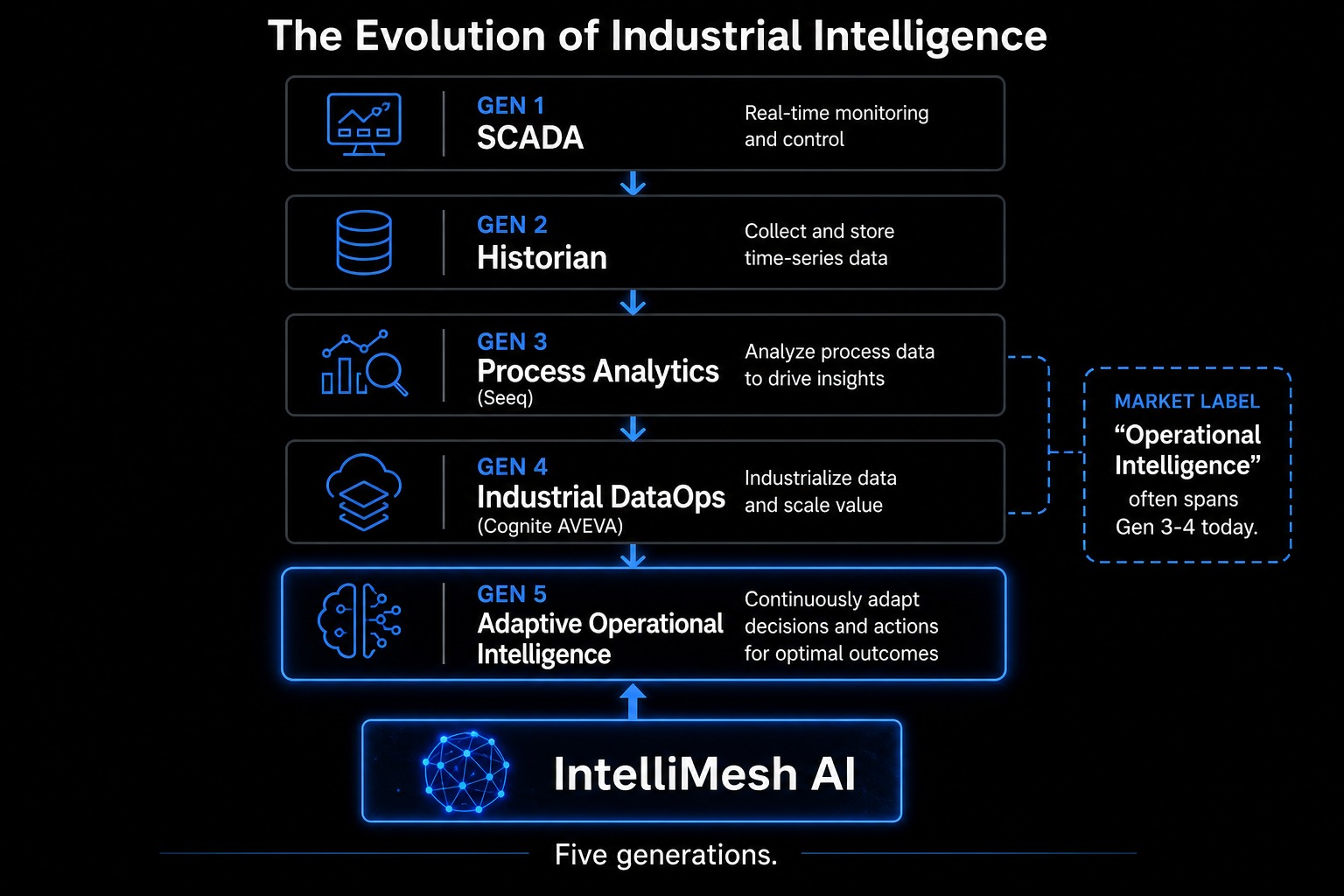
The Evolution of Industrial Intelligence

Instead of comparing vendors first, it helps to understand how industrial software has evolved over the last three decades.

Each generation solved a different operational challenge.

Generation 1 — Supervisory Control

Primary objective: Monitor equipment in real time.

Representative platforms include:

●     Ignition (Inductive Automation)

●     Wonderware

●     Siemens WinCC

●     FactoryTalk View

Primary capabilities:

●     Operator visualization

●     Alarms

●     Control

●     Human-machine interfaces

These systems answer:

"What is happening right now?"

They remain the operational backbone of most plants—and the right foundation to build on, not replace.

Generation 2 — Industrial Historians

Industrial historians transformed manufacturing by preserving operational history.


Examples include:

●     AVEVA PI System

●     Canary Historian

●     GE Historian


Primary capabilities:

●     Long-term storage

●     Trend analysis

●     Historical reporting

●     Process visibility


These systems answer:

"What happened?"


Historians are indispensable—but on their own they rarely close the loop from insight to improved production outcomes.

Generation 3 — Process Analytics

As manufacturers accumulated larger volumes of operational data, engineers needed better analytical tools.


This led to platforms such as:

●     Seeq

●     TrendMiner


Rather than simply displaying historical trends, these systems help engineers investigate process behavior.


Primary capabilities include:

●     Root cause analysis

●     Statistical process analysis

●     Event correlation

●     Engineering investigations


These platforms answer:

"Why did this happen?"


Seeq is often the benchmark in this category: powerful, engineer-centric, and widely adopted for time-series investigation across PI, OPC-UA, and cloud-connected sources.

Generation 4 — Industrial DataOps

The rapid growth of IIoT and cloud computing created another challenge: industrial data had become fragmented across plants, historians, ERP systems, MES platforms, and cloud services.


Industrial DataOps platforms emerged to solve this problem.


Representative platforms include:

●     Cognite Data Fusion

●     AVEVA CONNECT

●     Palantir Foundry


Primary capabilities include:

●     Enterprise data contextualization

●     Industrial digital twins

●     Cloud integration

●     Data governance

●     Asset relationships


These platforms answer:

"How do we organize industrial knowledge across the enterprise?"


Cognite and AVEVA CONNECT are strong examples: they unify disparate OT and IT sources into governed, contextualized models that scale across sites and business units.

Generation 5 — Adaptive Operational Intelligence (Emerging)

Today's industrial leaders are beginning to recognize that analytics alone are no longer enough.

Operational Intelligence is evolving beyond dashboards and reports toward systems that continuously improve industrial performance.

Rather than simply collecting data or analyzing historical trends, these systems combine:

●     Operational context

●     Adaptive machine learning

●     Maintenance workflows

●     Production optimization

●     Cloud-scale intelligence

into a continuously learning operational framework.


We refer to this emerging category as Adaptive Operational Intelligence.

Its objective is not simply to explain the past.

Its objective is to improve the future.


Where Leading Platforms Fit Today

No single vendor spans all five generations equally. Most excel in one or two layers. Mapping them by primary strength avoids apples-to-oranges comparisons.


●           Ignition — Gen 1 (extends to cloud/IIoT): What is happening right now—and how do we connect it?

●            AVEVA PI System — Gen 2: What happened, and how do we trend it?

●           Seeq — Gen 3: Why did this process event occur?

●           Cognite Data Fusion — Gen 4: How do we contextualize data across the enterprise?

●           AVEVA CONNECT — Gen 4: How do we unify OT data and applications in the cloud?

●            Honeywell Forge — Gen 4 → Gen 5 (performance & sustainability): How do we optimize performance and emissions across assets?

●           Splunk OT Security — OT visibility & security (adjacent): Is our OT environment visible, secure, and auditable?

●           IntelliMesh AI — Gen 5 (Adaptive Operational Intelligence): How do we continuously learn, predict, and optimize production?

This table is a category map, not a feature scorecard. Many deployments combine multiple layers—for example, Ignition + PI + Seeq, or Cognite + Forge—because each generation solves a distinct problem.


Platform Snapshots

Seeq — Process Investigation at Engineering Speed

Seeq is the reference platform for Generation 3 process analytics. Engineers use it to search, cleanse, model, and investigate time-series data from historians and live sources.


Where Seeq excels:

●     Fast root-cause analysis across large tag populations

●     Collaboration workflows for subject-matter experts

●     Strong connectivity to PI, SQL, OPC-UA, and cloud historians


Typical gap relative to Gen 5: Seeq helps teams understand why a deviation occurred. It does not, by default, close the loop with adaptive batch prediction, hourly device productivity scoring, performance failure profile matching, or maintenance-resolution feedback into production behavior—unless extended through custom integration.

Cognite & AVEVA — Enterprise Industrial DataOps

Cognite Data Fusion and AVEVA CONNECT represent Generation 4: contextualizing industrial data at enterprise scale.


Where they excel:


●     Unified data models across plants, assets, and systems

●     Digital twin and asset-hierarchy relationships

●     Governance, APIs, and cloud-native industrial applications


Typical gap relative to Gen 5: DataOps platforms organize knowledge exceptionally well. Turning that knowledge into per-device adaptive models that retrain from each plant's batch history—and feeding results into closed-loop maintenance KPIs—often requires additional application layers or partner solutions.

Honeywell Forge — Performance and Sustainability at Fleet Scale

Honeywell Forge spans performance monitoring, energy efficiency, and sustainability analytics across Honeywell's industrial portfolio.


Where Forge excels:

●     Fleet and site-level performance benchmarking

●     Energy, emissions, and reliability narratives for enterprise stakeholders

●     Integration with Honeywell's broad automation installed base


Typical gap relative to Gen 5: Forge is strong on enterprise performance visibility. Plants optimizing batch-level yield prediction, feedstock-specific regression, and explainable failure profiles tied to maintenance workflows may still need a complementary operational mesh at the production layer.

Splunk OT Security — OT Visibility and Security Intelligence

Splunk (including OT security and observability offerings) addresses a critical adjacent problem: visibility and security across OT networks, not production optimization per se.


Where Splunk excels:

●     OT asset discovery and security monitoring

●     Correlation of IT/OT events for incident response

●     Audit and compliance narratives for connected operations


Typical gap relative to Gen 5: Splunk answers "Is our OT environment secure and observable?" It is not primarily designed to answer "Why did this batch underperform—and what maintenance action improves tomorrow's yield?"

IntelliMesh AI — Adaptive Operational Intelligence

IntelliMesh AI targets Generation 5: a self-learning operational mesh that connects existing plant systems—including Ignition and the AWS Injector by Inductive Automation—into streaming pipelines that preserve OT investments while adding adaptive intelligence.


What distinguishes the approach:

●     Dynamic per-request regression training on historical batches—not a single static model frozen at deployment

●     Prediction-based anomaly baselines derived from expected batch outputs, not fixed thresholds alone

●     Multi-level health: hourly component metrics, device productivity trends, batch anomaly scores, and performance failure profiles

●     Closed-loop maintenance: alerts flow into operational workflows (e.g. Jira Service Management); resolution types feed back into simulation and production behavior


In our A5 simulation campaign, we measured this loop operationally: 21 closed-loop maintenance successes, 6/6 performance profile signature matches, and 100% directional agreement on the Jira cohort for process-trend validation—evidence that the mesh connects detection to resolution with traceable KPIs.


IntelliMesh does not replace Ignition, PI, or Seeq. It extends them: ingest tags you already have, learn from your batch history, and return explainable intelligence where production outcomes are decided.


Side-by-Side: What Each Layer Optimizes

What is the primary unit of analysis?

●     Seeq: Time-series signals and engineering investigations

●     Cognite / AVEVA CONNECT: Contextualized assets and enterprise data models

●     Honeywell Forge: Site and fleet performance, energy, sustainability

●     Splunk OT: Security events and OT network visibility

●     IntelliMesh AI: Device batches, productivity, component health, and maintenance loops

What does "learn" mean?

●     Seeq: Engineers build and share analytical workflows; ML-assisted features vary by deployment

●     Cognite / AVEVA: Models and apps built on governed data; learning is primarily platform- and app-centric

●     Honeywell Forge: Benchmarking and performance analytics across installed base

●     Splunk OT: Detection rules and security analytics refined over event corpora

●     IntelliMesh AI: Per-device models retrained from each plant's batch and sensor history at inference time

Does it close the maintenance loop?

●     Seeq: Investigation output; CMMS integration is deployment-specific

●     Cognite / AVEVA: Application-dependent; often requires custom workflow apps

●     Honeywell Forge: Performance recommendations; work-order depth varies

●     Splunk OT: Security incident response—not production maintenance optimization

●     IntelliMesh AI: Native path from alert → Jira/CMMS → resolution hooks → production behavior

Best starting point if you already have…

●     Ignition + PI: Add Seeq for investigation; add IntelliMesh for adaptive batch intelligence and closed-loop maintenance KPIs

●     Cognite or AVEVA CONNECT: Strong data foundation; add Gen 5 layer for per-device learning and productivity optimization

●     Honeywell-heavy site: Forge for fleet performance; IntelliMesh for process-layer yield and profile-based anomaly reasoning

●     OT security gap: Splunk OT for visibility; separate Gen 3/5 tools for process and production optimization


When to Use Which—or How to Combine

Invest in Generation 3 (Seeq-style analytics) when:

●     Engineers need fast, collaborative root-cause analysis

●     Historian data volume outpaces manual spreadsheet investigation

●     The primary pain is understanding complex process interactions


Invest in Generation 4 (Cognite / AVEVA DataOps) when:

●     Data is fragmented across sites, ERP, MES, and multiple historians

●     Enterprise digital twin and governance are prerequisites for scaling AI

●     Application teams need a unified industrial data API


Invest in Generation 5 (Adaptive Operational Intelligence) when:

●     Production outcomes—yield, throughput, energy, emissions—must improve continuously, not just be reported

●     You want models that adapt to each device and feedstock as new batches arrive

●     Maintenance workflows must close the loop with traceable KPIs, not stop at alerts


Add OT security visibility (Splunk OT) when:

●     Connected operations increase cyber-risk exposure

●     Compliance and incident response require unified OT event correlation


Combine layers on mature sites:

●     Ignition for real-time control and connectivity

●     PI or cloud historian for long-term storage

●     Seeq for engineering investigation

●     Cognite or AVEVA CONNECT for enterprise context (when scale requires it)

●     IntelliMesh AI for adaptive batch prediction, productivity scoring, profile signatures, and closed-loop maintenance


The future factory is not choosing between historians, analytics, and AI. It is composing them into a coherent operational picture.


From Dashboards to Continuously Learning Operations

The Operational Intelligence market is crowded because the underlying problems are real:

●     Plants drown in tags but starve for actionable context

●     Enterprise data platforms unify information but do not automatically optimize tomorrow's batch

●     Engineering analytics explain the past but often stop short of closed-loop improvement


Generation 5—Adaptive Operational Intelligence—addresses that last mile.


IntelliMesh AI is our answer at the production layer: connect what you already run in OT, train from your own batch history, score health and productivity together, match explainable failure profiles, and measure whether maintenance actions actually changed outcomes.


Seeq, Cognite, AVEVA, Honeywell Forge, and Splunk OT each play vital roles in modern industrial stacks. IntelliMesh is designed to extend those investments—not rip and replace them—by making operational intelligence continuously learning.
 

The future factory is not simply automated.

It is intelligent.


Learn More

●     Explore the IntelliMesh AI framework: How It Works

●     Read our foundation article: Building the Future of Industrial Intelligence with AI-Driven Predictive Maintenance

●     Compare mechanical CBM with process intelligence: Condition Monitoring vs. Operational Intelligence

●     Contact us for a demo focused on Ignition → Kinesis → health and productivity dashboards


References

  1. Inductive Automation — Ignition https://inductiveautomation.com/ignition/
  2. AVEVA — PI System https://www.aveva.com/en/products/pi-system/
  3. Seeq — Operational Intelligence for Process Manufacturing https://www.seeq.com/
  4. Cognite — Industrial DataOps Platform https://www.cognite.com/en/product/industrial-dataops-platform
  5. AVEVA — AVEVA CONNECT https://www.aveva.com/en/solutions/digital-transformation/aveva-connect/
  6. Honeywell — Forge https://www.honeywell.com/us/en/products/automation/forge
  7. Splunk — Industrial and OT Security https://www.splunk.com/
  8. IntelliMesh Systems — How It Works https://www.intellimeshai.com/howitworks
  9. IntelliMesh AI Blog — Building the Future of Industrial Intelligence https://www.intellimeshai.com/blog-posts/building-the-future-of-industrial-intelligence-with-ai-driven-predictive-maintenance
  10. IntelliMesh AI Blog — Condition Monitoring vs. Operational Intelligence https://www.intellimeshai.com/blog-posts/condition-monitoring-vs-operational-intelligence-how-assetwatch-and-intellimesh-approach-predictive-maintenance-differently


Explore How It Works