Europe’s biochar market is scaling under climate policy and permanent carbon-removal certification. IntelliMeshAI’s patent-pending self-learning pyrolysis software turns process physics into named failure-mode risk cards—reactor overheating, condenser leak, and feed miscalibration.
When biochar becomes infrastructure, “we have SCADA” is no longer enough. Europe’s operators need named failure-mode intelligence—before the train stops.
The Question Has Changed for European Biochar
Europe’s pyrolysis and biochar sector is no longer primarily a collection of pilot stories. Fixed-site and containerized plants, project developers, and O&M organizations are building toward multi-train, multi-site portfolios. Capital conversations assume long operating lives. Climate policy treats durable carbon removals as part of the industrial toolkit—not only as a slide in an ESG deck.
That maturity changes the software question.
It is no longer:
Can we get a plant to fire and make biochar?
It is becoming:
When we run several online trains across regions, can we see rising process risk early enough to protect uptime, yield, and the credibility of our climate delivery?
In our first Insights article, we argued that industrial AI must move past isolated anomaly detection toward contextual, explainable operational intelligence. In our comparison with mechanical condition monitoring, we showed why vibration/oil CBM and process-layer intelligence answer different questions. This piece brings that argument into a pyrolysis-specific, Europe-aware frame—and describes how IntelliMeshAI turns pyrolysis process physics into three named risk cards operators can act on.
Skim the comparison and IntelliMeshAI pyrolysis sections first—or expand failure-mode deep dives below for reactor, condenser, and feed arcs.
On this page
Jump to: Side-by-side comparison · IntelliMeshAI pyrolysis intelligence · Why Europe raises the bar · Failure-mode deep dives · When to pilot · Reliability and climate delivery
Side-by-Side Comparison
The comparison below summarizes how four platform layers answer different questions on online pyrolysis plants. Use it as a map—not a scorecard. Most sites already run SCADA and some mechanical CBM; the gap appears when a second and third train need named process risk and closed-loop maintenance—not another alarm flood.
Primary question
- SCADA / HMI: Is the plant in control now? Which tag is out of range?
- Mechanical CBM: Is this bearing / gearbox degrading?
- Generic OT analytics: What trend or threshold drifted?
- IntelliMeshAI Pyrolysis: Which failure mode is rising—and did maintenance work?
Primary data
- SCADA / HMI: Live tags, alarms, HMI states
- Mechanical CBM: Vibration, oil, motor/drive signals
- Generic OT analytics: Historian trends, tickets, spreadsheets
- IntelliMeshAI Pyrolysis: OT telemetry + batch-close KPIs + hourly health
What "health" means
- SCADA / HMI: In-range tags and alarm status
- Mechanical CBM: Mechanical asset degradation
- Generic OT analytics: Trend deviation from baseline
- IntelliMeshAI Pyrolysis: Component health + productivity + profile signature
Failure naming
- SCADA / HMI: Threshold alarm on a tag
- Mechanical CBM: Mechanical fault class
- Generic OT analytics: Generic anomaly / high temperature
- IntelliMeshAI Pyrolysis: Named profiles (overheating, condenser leak, feed calibration)
Productivity vs expected
- SCADA / HMI: No
- Mechanical CBM: No
- Generic OT analytics: Limited batch compare / reporting
- IntelliMeshAI Pyrolysis: Predicted batch yields (biochar, bioliquid, gas, energy)
Maintenance loop
- SCADA / HMI: Operator alarm response
- Mechanical CBM: CBM work order
- Generic OT analytics: Ticket or spreadsheet follow-up
- IntelliMeshAI Pyrolysis: Jira/ITSM → mitigation → recovery KPIs
Fleet comparability
- SCADA / HMI: Site-specific screens
- Mechanical CBM: Asset-class baselines
- Generic OT analytics: Varies by deployment
- IntelliMeshAI Pyrolysis: Same component language across trains and sites
Best for
- SCADA / HMI: Real-time control and safety
- Mechanical CBM: Rotating equipment reliability
- Generic OT analytics: Reporting and investigation
- IntelliMeshAI Pyrolysis: Multi-train EU O&M under CRCF-era scrutiny
IntelliMeshAI Pyrolysis: Built on Process Physics
Generic industrial AI often treats every tag as an anonymous time series. Pyrolysis does not work that way.
IntelliMeshAI is grounded in how these plants actually behave:
- Thermal paths — reactor temperature fields, heat-up dynamics, and overheating progression that threaten materials and force outages
- Condensing trains — where liquid yield, cooling integrity, and leak-like signatures show up before a hard stop
- Feed and mass balance — feedstock rate and calibration errors that quietly break the relationship between inputs and biochar / bioliquid / gas outputs
- Batch economics — expected yields and energy use given feedstock and process conditions, so “busy” is not confused with “productive”
That domain model sits underneath our software: component health taxonomies (reactor, condenser, feed, and related systems), predicted vs. actual productivity, named performance behaviors, and failure-mode risk scoring with explainable drivers.
IntelliMesh has a patent-pending process for Self-Learning Pyrolysis Device Optimization and Anomaly Detection—methods that combine on-the-fly learning from batch history, multi-level health and productivity scoring, and pattern recognition of process failure modes.
The point for operators is practical: the platform was designed around pyrolysis physics and O&M language, then proven as software you can walk through—not retrofitted from a generic “anomaly score.”
What distinguishes the approach
- Pyrolysis-native taxonomies — reactor, condenser, feed, and related systems use the same language as plant engineering drawings
- Named performance profiles — overheating, condenser-stress, feed-calibration error, and nominal baselines—not anonymous anomaly scores
- Risk cards with drivers — criticality rises with explainable process features operators can brief against
- Closed-loop maintenance — resolution types feed back into simulation and production behavior so “fixed” is measurable
See How It Works for the architecture overview.
How the software puts physics to work
CEOs should ask what “AI for pyrolysis” actually computes. In plain language, IntelliMeshAI:
- Ingests live process telemetry into hourly component health (reactor, condenser, feed, and related systems)—using taxonomies that match how plants are engineered.
- Scores completed batches for productivity: actual yields and energy use versus predicted baselines from feedstock and process conditions (biochar, bioliquid, biogas, energy, conversion). Predictions improve as batch history grows—the self-learning loop in our patent-pending methods.
- Recognizes named process behaviors (reactor overheating, condenser-stress, feed-calibration error, nominal baselines) so the system speaks O&M language, not only statistical outliers.
- Scores rising failure-mode risk with explainability, surfaced in the operator experience as risk cards (criticality and drivers, not a black-box percentage alone).
- Closes the maintenance loop through resolution and recovery workflows—so health history reflects “fixed,” not only “alarmed,” and learning can account for what actually restored the plant.
We exercise these paths end-to-end on physics-informed pyrolysis digital twins that emit the same class of live and batch telemetry a real Ignition-connected plant would—so architecture and failure-mode UX can be evaluated rigorously before tying every claim to a single commercial uptime calendar. The intelligence services are the product; the twin is how we pressure-test them against known process progressions.
Why Europe Raises the Bar
North American biochar build-out is still often early-stage: first commercial fires, host-site politics, and proof that nameplate capacity can become sustained production. Parts of Europe already operate with a different baseline:
- Climate as industrial strategy. Long-horizon investment and public policy assume plants will run for decades, not just through a funding cycle.
- Certification and scrutiny. The EU’s Carbon Removals and Carbon Farming (CRCF) framework—and 2026 methodologies for permanent removals including biochar carbon removal (BCR)—are shaping how serious offtake and climate claims will be judged. The framework is voluntary, but market-defining: operators who want durable recognition will need defensible monitoring, continuity, and process integrity, not only a good lab analysis of one batch of char.[1–6]
- Multi-plant O&M as the normal case. Specialists are scarce. Remote visibility matters. Alarm floods do not scale.
- Greenwashing risk. “We collect a lot of tags” is not the same as “we can explain which failure mode is rising and what to do.”
None of that replaces good mechanical maintenance. It does mean process predictability sits closer to the CEO agenda than it does in markets still arguing about first fire.
When to Pilot—and What to Combine
Most online pyrolysis plants already have some combination of PLC / SCADA (often Ignition-class edge), local HMI alarms and historian trends, tickets or spreadsheets for maintenance follow-up, and optional mechanical CBM on motors, fans, and drives.
That stack is necessary. It is not sufficient for fleet O&M. The process layer IntelliMeshAI is built for adds:
- Fleet-comparable health — same component language across sites
- Named early warning — “condenser leak risk Critical,” not only a single high temperature tag
- Productivity vs. expected — batch outputs scored against predicted baselines rooted in process conditions
- Closed loop — risk → work → recovery, so the organization learns what “fixed” looks like
If your market is already mature enough for multi-site O&M and certification-aware offtake, a useful pilot is narrow:
- One online train with reliable live tags and batch-close KPIs (Ignition-class edge preferred).
- Fleet-comparable device health with pyrolysis component language.
- One risk card first—usually reactor thermal—then condenser and feed once sensor coverage is confirmed.
- Success criteria ops trust: earlier, named warning that specialists act on—not another dashboard nobody opens.
You do not need to rip out SCADA. You do not need to abandon mechanical CBM. You need software that turns pyrolysis telemetry into failure-mode language, grounded in how the process actually fails.
Three Failure Modes (deep dives)
O&M teams do not think in abstract “anomaly scores.” They think in failure modes that stop trains, spoil yield, or force messy recoveries. We focused proving effort on three that repeatedly matter for continuous / online pyrolysis-class plants—and delivered each as an operator-facing risk card with rising criticality and explainable drivers. Expand each arc below.
1. Reactor overheating
Physics / ops: Thermal excursions stress heaters and refractory, force unplanned stops, and drive sharp yield cliffs. Once the plant is in a hard excursion, you are in recovery—not optimization.
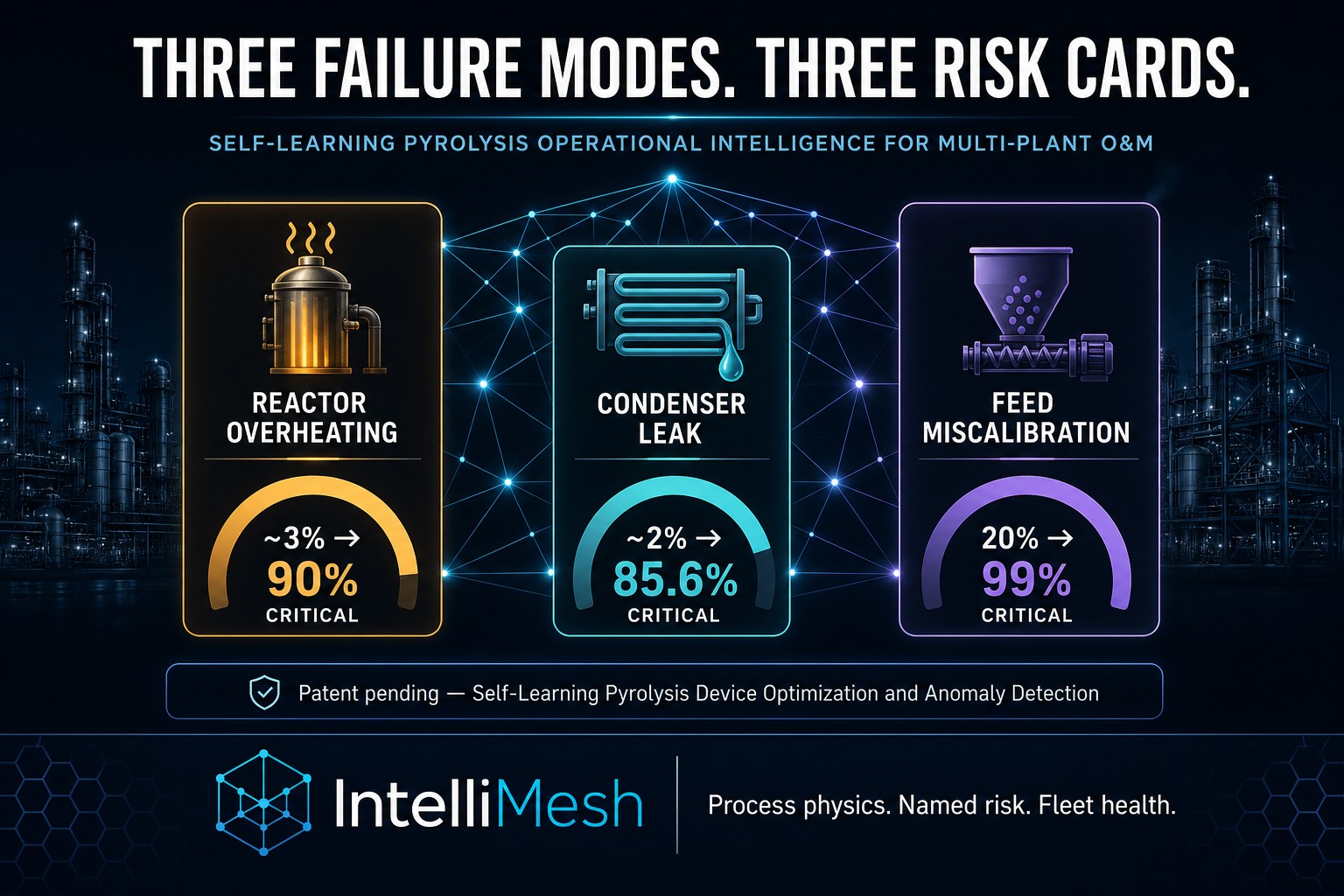
Software outcome: Reactor Overheating Risk demonstrated a full arc from ~3% to 90% Critical as thermocouple-field and related process features accumulate evidence—early enough to brief O&M before a hard trip becomes the first signal.
2. Condenser leak
Physics / ops: Condensing integrity governs bioliquid yield and quality; leak-like behavior creates messy environmental and housekeeping outcomes and long specialist recoveries. Multi-site O&M feels this as “the quiet train that suddenly isn’t.”
Software outcome: Condenser Leak Risk demonstrated a full arc from roughly ~2% to 85.6% Critical—visible as a predictive card, not only as after-the-fact alarms.
3. Feed miscalibration
Physics / ops: Feed rate and calibration errors break mass balance. Biochar and liquid outputs stop matching the recipe; carbon-accounting and offtake narratives get fragile even when the HMI still “looks busy.”
Software outcome: Feed Calibration Risk demonstrated an arc from ~20% to 99% Critical—again as a named card operators can train and staff against.
The pattern that matters
- Reactor overheating: ~3% → 90% Critical
- Condenser leak: ~2% → 85.6% Critical
- Feed miscalibration: 20% → 99% Critical
In short for technical teams: each failure mode surfaces as a live risk card—and fleet health correlates when process sensors evaluate.
That last phrase matters. Fleet list health is useful when it moves with the underlying component evaluation—not when it is a disconnected traffic light.
Closing: Reliability Is Part of Climate Delivery
Europe’s pyrolysis market is maturing under a different mix of policy, capital patience, and climate accountability than earlier-stage regions. That is a strength. It also raises the bar: plants that cannot see reactor, condenser, and feed risk rising will struggle to deliver the predictable operations long-horizon biochar and removal narratives require.
IntelliMeshAI exists to close that gap—with a patent-pending Self-Learning Pyrolysis Device Optimization and Anomaly Detection approach, software built around pyrolysis process physics, and three risk cards we have already walked through end-to-end.
If you lead a European biochar / pyrolysis developer, OEM, or O&M organization and want a short walkthrough of the three arcs, start at How It Works or reach out via intellimeshai.com. We are glad to speak with CEOs and technical leads together—policy context for leadership, risk cards for the people who keep trains online.
Learn More
EU CRCF & BCR — references
Sources supporting the certification and scrutiny paragraph above (as of August 2026):
- Regulation (EU) 2024/3012 — Establishes the voluntary Union certification framework for permanent carbon removals, carbon farming, and carbon storage in products; sets QU.A.L.ITY-style criteria (quantification, additionality, long-term storage, sustainability), independent third-party auditing, monitoring/reporting rules, and traceability via certification schemes and a Union registry.
EUR-Lex — Regulation (EU) 2024/3012
- European Commission, Climate Action — CRCF Regulation overview — Describes CRCF as a voluntary EU-wide framework intended to build trust in removals, counter greenwashing, and harmonise certification through recognised schemes—while schemes are not obliged to seek recognition to operate.
Carbon Removals and Carbon Farming (CRCF) Regulation
- Commission Implementing Regulation (EU) 2025/2358 (applicable from 11 December 2025) — Operational rules for CRCF certification schemes, certification bodies, and audits that underpin credible certification in practice.
EUR-Lex — Implementing Regulation (EU) 2025/2358
- Commission Delegated Regulation (EU) 2026/285 (adopted 3 February 2026; published in the Official Journal 17 April 2026) — First CRCF certification methodologies for permanent carbon removals, covering DACCS, BioCCS, and biochar carbon removal (BCR). BCR operators must meet eligibility rules, defined activity and monitoring periods, quantification and liability rules, sustainability requirements, and monitoring and reporting plans subject to certification audit—not a one-off product test.
EUR-Lex — Delegated Regulation (EU) 2026/285 · EC press release, 3 February 2026
- European Commission — CRCF certification methodologies timeline — Tracks delegated-act development, including the May 2024 review of carbon removals through biochar and the path to the 2026 permanent-removals methodology.
Certification methodologies — Climate Action
- European Commission — EU Carbon Removal Certification: Biochar Methodology workshop (18 June 2024) — Expert-group and stakeholder process on BCR methodology development, monitoring, and QU.A.L.ITY criteria—background to why operational continuity matters beyond lab char analysis.
Biochar methodology workshop
Policy note: References to the EU CRCF and biochar carbon removal methodologies describe the emerging market and certification context as of 2026. IntelliMesh is not a certification body and does not claim CRCF certification by virtue of this software.