Risk cards and telemetry are necessary but not enough. See how feedstock physics and recipe process feedback turn IntelliMesh into Adaptive Operational Intelligence—scoring the run, not only the machine.
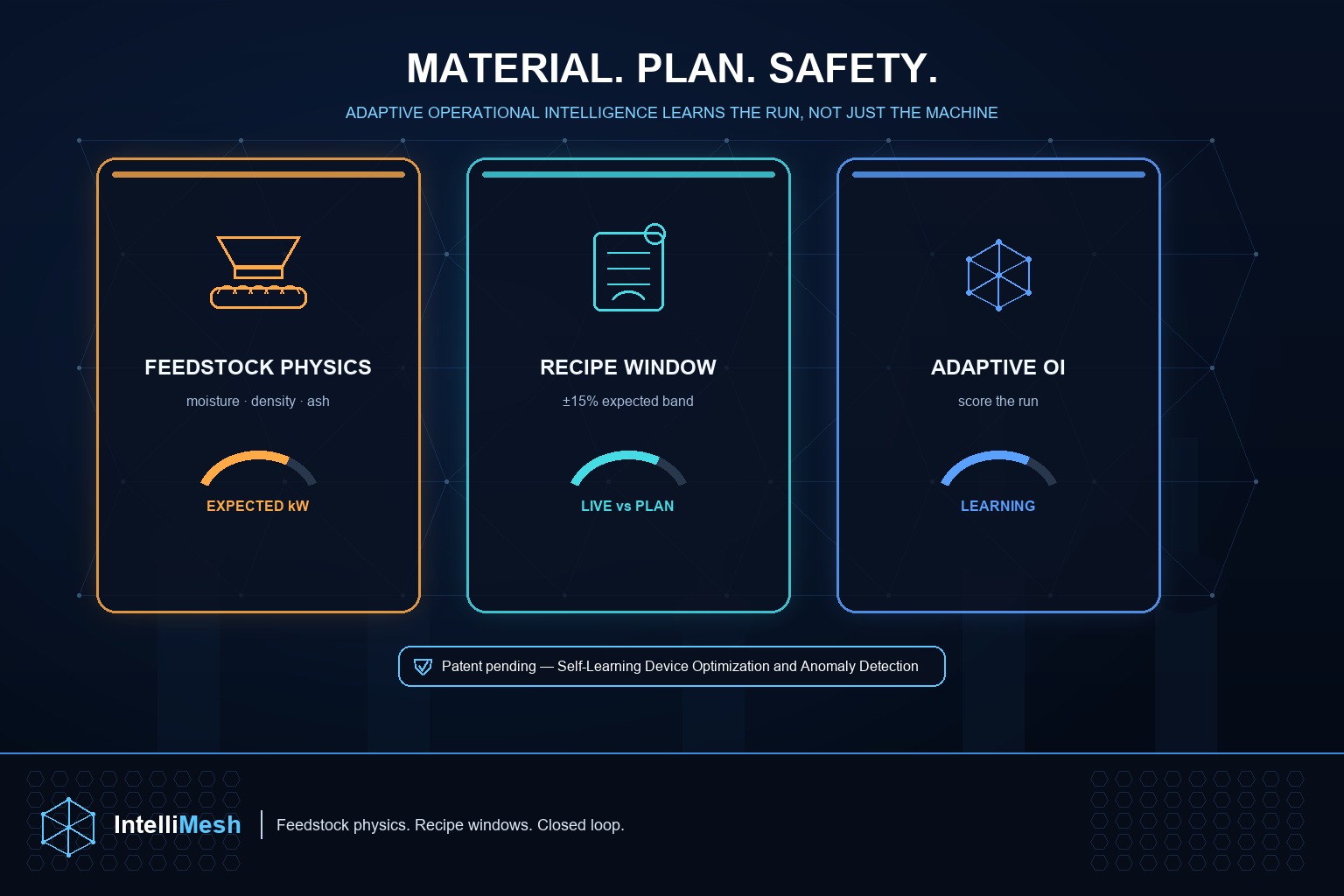
Telemetry without material and recipe context optimizes yesterday’s plant. Adaptive Operational Intelligence begins when the mesh knows what you intended to run—and what the feedstock can actually do.
In our platforms comparison, we described five generations of industrial software and named the emerging category Adaptive Operational Intelligence: systems that do not only explain the past, but continuously improve production.
In our EU pyrolysis risk-card article, we showed how process physics becomes operator-ready early warning—reactor overheating, condenser leak, and feed miscalibration.
Those pieces established the destination and the failure-mode language. They left a practical question open:
When the hopper changes, or the run plan changes, what does “good” mean for this batch?
That is not a dashboard question. It is the difference between scoring a correct wet run as a broken dry plant—and scoring it as the run you planned.
This article closes that loop. It shows how feedstock physics (material truth) and recipe process (named run plan) feed back into prediction, Device Health, and profile signatures—so the complete IntelliMesh system gets sharper without rewriting safety.
Skim the three contexts and feedback loop first—or expand deep dives below for the pyrolysis walkthrough, brewery parallel, and what improves when physics and recipe feed back in.
Jump to: Why telemetry alone is not enough · Three contexts · The closed feedback loop · Deep dives · What this is not · Adaptive Operational Intelligence in practice
Most online plants already stream plenty of tags: reactor power, auger speed, temperatures, ferment setpoints, energy meters, yields.
Without material and plan context, those tags answer only half the question.
· Is power high—or high for 35% moisture at this dry rate?
· Is auger speed “wrong”—or still calibrated to last week’s wood chips after the site switched to denser tire chips?
· Is ferment duration off—or off relative to this recipe’s expected hours?
Generic anomaly detection treats every tag as an anonymous time series. Process plants do not work that way. Moisture, density, particle size, ash, grist, yeast, and mash plan change what normal looks like—often while device safety ceilings stay fixed.
Adaptive Operational Intelligence requires both:
· What the machine is doing (OT telemetry, component health, risk cards)
· What the run was supposed to be (feedstock physics + recipe brief)
Without the second half, learning systems optimize against the wrong baseline.
IntelliMesh separates three layers that plants often collapse into one spreadsheet cell. Expand each context below.
The feedstock card holds the material truth: physics class, moisture, ash, bulk density, particle size, and related properties. From a complete card, the platform produces an operating brief—expected auger behavior, heater load, yields, and advice grounded in mass and energy balance.
Feedstock answers: What is this material, and what should the plant expect from it?
A recipe is not a synonym for feedstock. It is the intentional plan for this run: product intent (for example max char vs balanced vs gas), charge, target dry rate—or, in brewing, grist, mash, and fermentation plan.
On save, a complete recipe carries an expected brief: power, auger, reactor target, yields—or ferment temperature, duration, cooling and electricity, beer liters, and ABV.
Recipe answers: How did we intend to run this batch on that material?
Safety thresholds stay on the device. Changing feedstock or saving a recipe does not rewrite severe limits. The brief is calibration and expectation—not a soft rewrite of the trip.
Safety answers: What must never be violated, regardless of plan?
Keeping those three distinct is what makes adaptation honest. Material without a plan invents a false “good.” A pretty recipe without material physics ignores moisture and density. Softening safety to fit a wet run is not intelligence—it is risk transfer.
Here is how the complete system improves when feedstock and recipe are fed back in.
1. Catalog the material. Complete the feedstock physics card. When the card is complete, the platform regenerates the feedstock operating profile used by feed-calibration and related paths.
2. Name the plan. Create or select a recipe linked to that feedstock. Preview and save the brief so expected columns are explicit for operators and for software.
3. Attach both to the batch. Batch update carries feedstock and recipe into the operational mesh—the same path simulation twins exercise when configs attach feedstock and recipe IDs.
4. Score against the plan. Device Health can show live tags beside recipe expectations—for pyrolysis, power and auger (MOT002) within a ±15% recipe window; for brewery, ferment temperature, duration, cooling/electricity, beer liters, and ABV.
5. Separate plan match from failure mode. Profile signatures still hunt named failure progression. When live feed behavior matches the feedstock brief, the platform can withhold a false “feed miscalibration” ranking—so dialing in a new material correctly is not treated as a fault.
6. Keep risk cards about real progression. Reactor, condenser, and feed risk cards remain failure-mode intelligence. Feedstock and recipe make “good for this run” separable from “fault developing.”
That loop is Adaptive Operational Intelligence in operational terms: continuously improving tomorrow’s batch because today’s mesh knew the material and the plan.
Optional detail—expand each section below for the pyrolysis walkthrough, brewery parallel, and what improves when physics and recipe feed back in.
Hold a dry-rate target near 22.5 kg/h and change only moisture.
· 10% moisture — about 25 kg/h wet, ~9.7 kW expected heater power, inside the warning band
· 35% moisture — about 35 kg/h wet, ~15.7 kW, past the ~15.4 kW warning
· 45% moisture — about 41 kg/h wet, ~19.7 kW, into severe territory
Same dry solids target. Completely different “normal” power. A system that only knows last month’s dry-wood baseline will score a correct wet run as unhealthy—and may tempt someone to raise the severe limit instead of drying feed or slowing the dry rate.
The feedstock brief does the opposite: it tells the operator to dry or slow, and it states that the severe ceiling stays put.
Change material class instead of moisture. Tire chips at low moisture and higher density need a lower auger speed for the same dry rate. Leave the screw where wood was calibrated and you deliver far more mass than the plan. Heater load may look fine because the chips are dry—while mass balance is already wrong. The brief surfaces the new speed before the batch becomes a post-mortem.
On Device Health, a complete pyrolysis recipe adds another operator cue: live power and MOT002 scored against the recipe’s expected values. Outside the recipe window, inside safety, is actionable process language—not another anonymous red tag.
Brewing already lives on recipes. The Adaptive Operational Intelligence question is whether the operational mesh treats the recipe as decorative metadata—or as the expected process window for this batch.
IntelliMesh brewery recipes carry grist, moisture, extract, crush, yeast, and mash parameters into an expected brief: beer liters, ABV, ferment temperature and hours, cooling and electricity. Device Health can caption live tags against those expectations with the same ±15% window idea used in pyrolysis.
The industrial point is category-level, not niche:
· Material (or grist) physics defines what the process can do
· Recipe defines what this run intended
· Telemetry and risk intelligence judge the live plant against both
· Safety and mechanical CBM remain their own layers
That is why Adaptive Operational Intelligence is not “more SCADA charts.” It is process-aware scoring that travels across industries that already think in batches and named plans.
Honest cold starts. When batch history for a feedstock is thin, a complete physics card supplies a versioned physics prior for expected yields and productivity—so the first runs of a new material are not scored against literature defaults that ignore ash, moisture, and class split.
Fewer false failure stories. Feed-calibration and related signatures compare live behavior to feedstock expectations. Matching the brief can suppress a false miscalibration ranking. Operators stop chasing ghosts when they correctly dialed the new material.
Operator language that matches the plant. “Outside recipe window” is different from “severe.” One asks for process adjustment or plan review. The other is a safety ceiling. Collapsing them into a single anomaly score creates alarm fatigue and wrong work orders.
Fleet-comparable learning. When batches carry feedstock and recipe identity, fleet models and leave-one-unit-out validation learn across units without pretending every run was the same material and intent. Comparable health requires comparable run context.
Closed-loop maintenance that stays about failure. Risk cards and maintenance workflows remain focused on named progression—reactor, condenser, feed, and related modes. Material and recipe context protect those cards from being polluted by planned operating changes.
Clarity matters as much as ambition.
· Not a rewrite of safety. Recipe and feedstock briefs do not lift severe thresholds.
· Not a replacement for mechanical CBM. Vibration and oil analysis still answer bearing and gearbox questions; process intelligence answers yield, energy, and failure-mode progression.
· Not finished plant kinetics sold as settled science. The physics prior is an engineering model, versioned so it can improve. Self-learning from batch history and maintenance resolution remains the adaptive overlay—not a claim that every coefficient is fitted field truth on day one.
Adaptive Operational Intelligence earns trust by saying what each layer owns.
Return to the Generation 5 definition: continuously improve industrial performance—not only explain yesterday’s trend.
The complete IntelliMesh system already connects OT telemetry, component health, productivity scoring, named risk cards, and closed-loop maintenance. Feedstock physics and recipe windows are what make that mesh adaptive to the run:
· Change the material → the brief changes before the fault story starts
· Change the plan → Device Health scores the new expectation, not last week’s
· Match the brief → false failure rankings stay quiet
· Miss the brief inside safety → operators get process language, not mystery anomalies
· Breach safety → ceilings still mean what they meant yesterday
That is how the system gets better when the physics of the feedstock and the process of the recipe are fed back in.
The future factory is not simply automated. It is not merely monitored. It learns the run it was asked to run—and improves the next one.
Learn more at How It Works.
· Building the Future of Industrial Intelligence with AI-Driven Predictive Maintenance
· Operational Intelligence Platforms Compared: Where IntelliMesh AI Fits
· Europe’s Pyrolysis Market Is Maturing. Is Plant Reliability Keeping Up?
· Condition Monitoring vs. Operational Intelligence
· Fermentation Monitoring vs. Operational Intelligence: Brewery Platforms Compared
