Ignition and AVEVA already page the control room. Adaptive Operational Intelligence decides which alarm is worth waking someone who is not standing in front of the screen—and which ones should stay on the list.
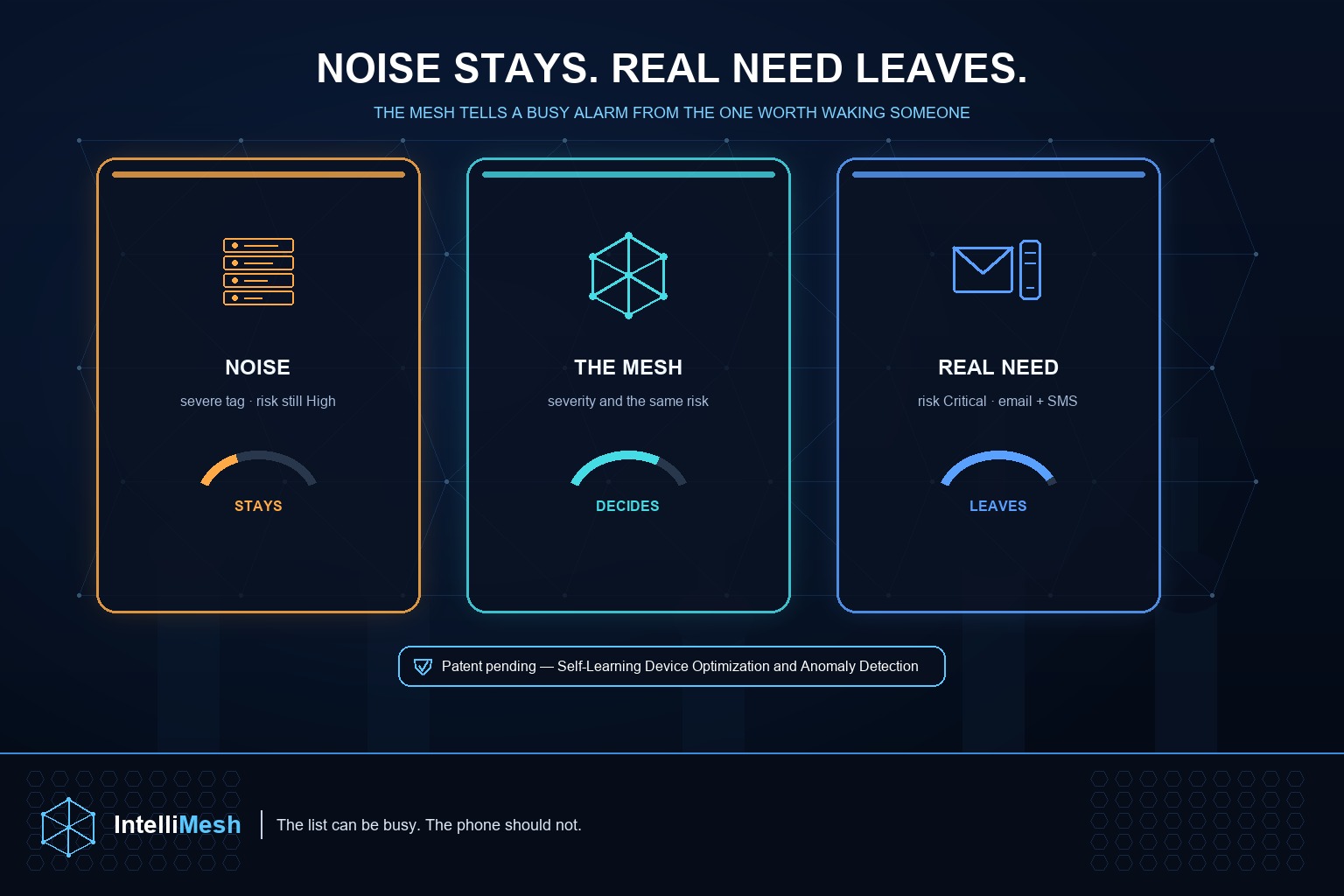
A severe tag is not the same event as a severe tag while the run’s risk is Critical. One belongs on the list. The other is worth waking someone.
In our platforms comparison, we placed Ignition in Generation 1 and the AVEVA PI System and AVEVA CONNECT in Generations 2 and 4. The point of that map was not a winner. Each generation answers a different question, and IntelliMesh is meant to extend the stack you already run.
In our feedstock and recipe article, we asked what “good” means for this run once the mesh knows the material and the plan. Scoring the run is only useful if the right person hears about the run that is actually going wrong.
That is the next question:
When should an alarm leave the plant?
Leave, here, means email or SMS to a person who is not looking at the screen. The control-room banner, the horn, and the list inside the product are a different channel. They can be busy. The phone should not be.
Jump to: What Ignition and AVEVA already do well · Where a plant pipeline stops · What each layer should own · How Adaptive Operational Intelligence decides · A pyrolysis hour · What this is not
Ignition’s alarm notification pipelines are the clearest version of this idea on the plant floor. A pipeline is a sequence of steps. A delay step waits. A splitter sends the same alarm down two paths. A notification step emails or texts a roster. A switch or expression step carries a condition, so the next step runs only when that condition is true. The roster knows who is on call.
AVEVA’s plant software has the same job in a different shape. Alarm strategies, escalation delay, and the people defined inside the system decide who hears a horn or gets a message. The operator display is the product. If your site already runs System Platform, InTouch, or PI for the live plant, that is where the banner belongs.
Those are real strengths, and a serious operations team should keep them.
· The operator who is standing at the panel needs the alarm now, on that panel.
· A delay before the next person is called is the right shape. Someone in the room should get the first chance to acknowledge.
· A condition on the step is the right idea. Not every alarm should take the same path.
· A roster is better than a hardcoded list of phone numbers that all ring at once.
IntelliMesh does not need to redraw that designer, and it should not ask a plant to abandon the HMI that already annunciates.
The pipeline runs where the plant software runs. That is also the limit.
A site with no Ignition gateway has no Ignition pipeline. A site with no AVEVA alarm strategy has no AVEVA escalation. When the gateway, the network, or the license is the thing that failed, the local pipeline is down at the moment the plant most needs a person.
The other limit is what the condition can see. An expression on a gateway step can test a tag, a severity, and a schedule. It cannot see that this reactor hour is Critical risk because the last several hours of the run, the feedstock, and the failure-mode model agree. A severe temperature can be ordinary for this recipe. A severe temperature while reactor-overheating risk is Critical is a different event. Tag logic flattens those into one alarm, and then the roster gets all of them.
That volume is the practical failure. Hundreds of warning and severe emails do not make a plant safer. They train people to ignore the phone. The list can hold that volume. The inbox should not.
· Ignition: Alarm pipelines, delay, splitter, roster, and a condition on the step, running in the gateway
· AVEVA: Alarm strategy and escalation inside the plant software
· IntelliMesh: Leave this on the plant system. Where a gateway is present, the existing tag feed can still light a local banner. That feed is a display.
· Ignition and AVEVA: The alarm client at the plant
· IntelliMesh: The nav bell and the alerts page. Critical, severe, and warning show up there as soon as the alert exists. Opening the list is not an acknowledgement. Acknowledging on the page is.
· Ignition and AVEVA: Strong when the plant software is up and the roster lives there. Silent when it is not.
· IntelliMesh: The rare path. A Critical or Severe alert leaves the plant only when the risk for that same condition is Critical. Warning stays on the bell. A severe hour at a lower risk stays on the bell.
· Ignition: Delay step, then the next roster contact, if the pipeline condition still passes
· AVEVA: Escalation delay on the strategy
· IntelliMesh: The same shape, evaluated again after the wait. If the risk is no longer Critical, the next person is not paged.
· Ignition and AVEVA: Available as an add-on in many deployments
· IntelliMesh: Not this version. Email, SMS, and the on-screen list are enough. A phone call is a later decision, not a default.
Adaptive Operational Intelligence, as we defined it, does not only explain yesterday. It gets sharper about this run. The notification rule is that idea applied to a person.
The mesh already holds two facts that a gateway expression usually does not hold together:
· The alert severity on the unit
· The named risk for the same condition, taken from the model for that plant
The names belong to the plant. On a pyrolysis unit the model uses reactor overheating, condenser leak, and feed calibration, the cards in the pyrolysis risk article. On a brewery it uses fermentation temperature, glycol and chiller capacity, and yeast and yield, the cards in the brewery article. A card from one plant does not qualify an alarm on the other.
A Critical condenser risk does not qualify a reactor alert. A Critical chiller risk does not qualify a fermentation alert. The condition has to match the alarm. No risk score means the alarm stays on the list. Missing context is not a reason to text someone.
The levels are switches, not a script. Critical and Severe start on. Warning and Info start off. Risk Critical starts on. High, Elevated, and Low start off. Both groups have to match before an email or a text is sent. A company can turn a level off, and a site can replace the company switches without changing every other site. That is the Ignition condition block, aimed at the run rather than at a single tag.
The bell does not use those switches. A logged-in user still sees the busy day. The phone is reserved for the hour that is actually severe in the sense that matters: the alarm is Critical or Severe, and the risk card for that failure mode is Critical.
Two consequences follow. The loop below is that rule in motion.
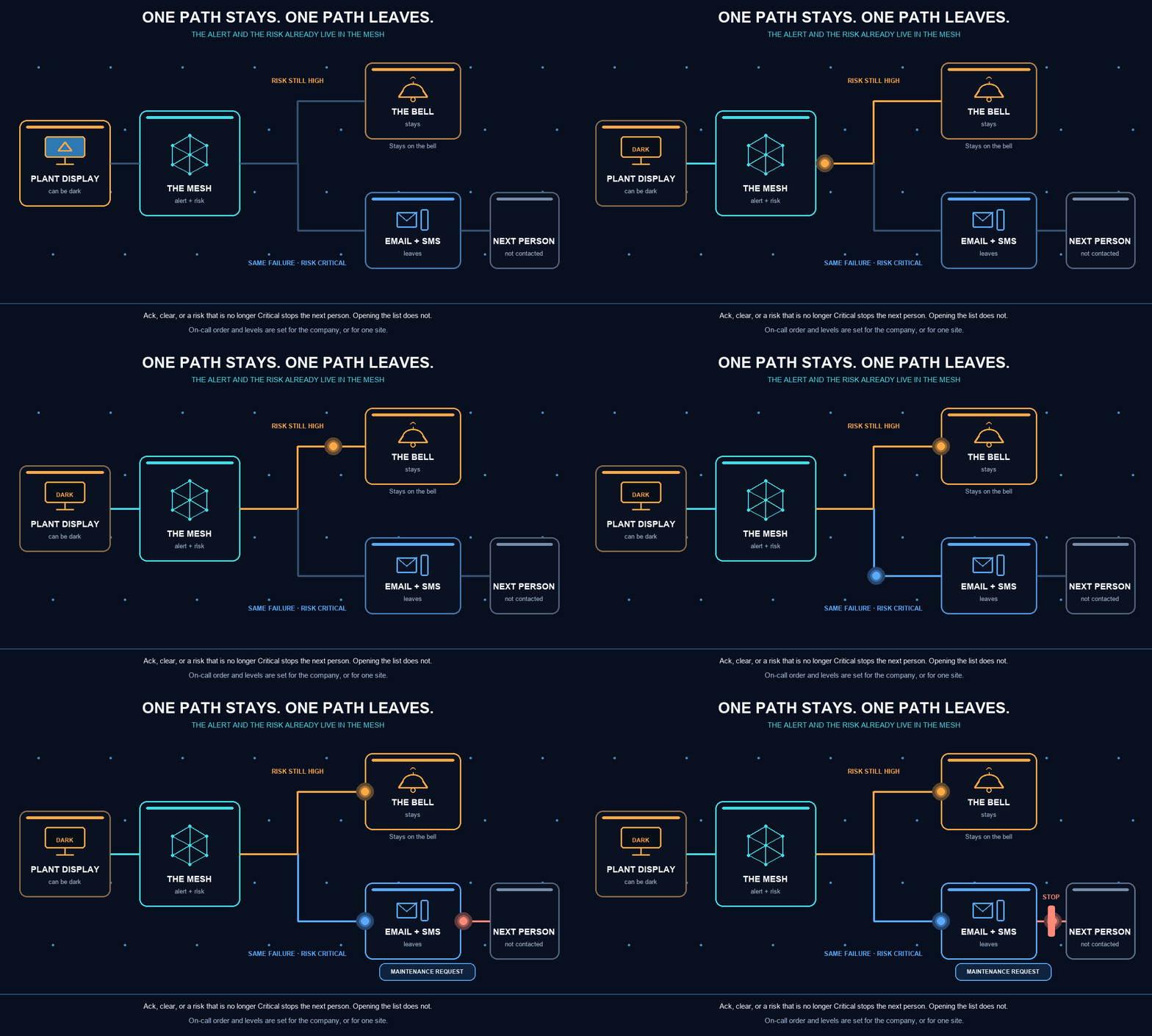
One path stays on the bell. One path leaves by email and SMS, and opens the maintenance request. Acknowledging, clearing, or a risk that drops stops the next person.
The page still goes out when the gateway is down, because the alert and the risk already live in the mesh. The plant display can be dark and the person on call can still hear about a Critical reactor hour.
The page does not go out for the rest. A severe tag with risk still High is an operator event. It stays on the bell. Collapsing those, as we said about recipe windows, is how alarm fatigue and the wrong work order get created.
That rule is in the product. A company sets the on-call order and turns each level on or off, for the company or for one site. A Critical or Severe alert whose risk for that same failure is Critical emails and texts the first person, and the same condition opens the maintenance request. The bell stays the busy list. Opening it is not an acknowledgement. Acknowledging on the alerts page, clearing the alert, or a risk that is no longer Critical stops the next person.
Take the three failure modes from the risk-card article: reactor overheating, condenser leak, and feed miscalibration.
A reactor hour goes severe while overheating risk is still high, not Critical. The bell lights. The alerts page has the row. Nobody is texted. If an operator acknowledges it, the story ends on the page.
A later hour on the same unit crosses into reactor-overheating risk Critical, the arc those cards already show from a low single-digit score to a Critical one. That hour leaves the plant. The person on call gets one email and one SMS that name the unit, the component, and the alert. The same condition opens the maintenance request, so the phone and the work order describe one event. If someone acknowledges it, the next person is not contacted. If the risk falls back below Critical during the wait, the next person is not contacted either.
A condenser risk that is Critical does not send the reactor message. The feed-calibration card does not borrow the reactor’s severity. Each condition qualifies itself.
A brewery hour is the same decision on that plant’s cards. Fermentation temperature, glycol and chiller capacity, and yeast and yield each qualify only themselves. A Critical glycol risk does not page someone about the fermenter. The model changes with the plant type. The question does not: is this alarm the same condition as a Critical risk card?
Warning hours never take this path under the default switches. They remain visible. They do not become a second inbox.
· Not a replacement for Ignition or AVEVA. Keep the HMI, the horn, and the local pipeline. The mesh does not annunciate the panel.
· Not a feature scorecard. Generation 1 and Generation 2 are still the right answer to “what is happening” and “what happened.” This post is about who should be interrupted.
· Not every severe alarm. Severity alone is how inboxes die. Critical risk on the same failure mode is the qualifier.
· Not a script editor. Sites turn levels on or off. They do not maintain a private expression language.
· Not voice. Email and SMS, plus the list, are the channels.
· Not a second alarm designer. The roster, the on/off levels, the wait, and the maintenance request are in the product. A site does not draw a private pipeline for each plant.
Adaptive Operational Intelligence earns trust by saying what each layer owns, and by staying quiet when the run does not justify a page.
Return to the definition: continuously improve the run, not only explain the tag.
· The plant system owns the room.
· The bell owns the working list, including the warnings nobody should be texted about.
· Email and SMS own the rare hour: Critical or Severe, and risk Critical for that same condition.
· The condition is checked again after the wait, so a recovered hour does not wake the next person.
· A site can tighten or loosen the switches without inventing a new pipeline.
That is how the stack in Operational Intelligence Platforms Compared: Where IntelliMesh AI Fits stays intact, and how the run context from From Feedstock Physics to Recipe Windows changes a person’s day. The mesh learned what this hour means. The phone rings only when that meaning is Critical.
The future factory is not the one that forwards every alarm. It is the one that knows which alarm should leave the plant.
Learn more at How It Works.
· Operational Intelligence Platforms Compared: Where IntelliMesh AI Fits
· From Feedstock Physics to Recipe Windows
· Europe’s Pyrolysis Market Is Maturing. Is Plant Reliability Keeping Up?
· Condition Monitoring vs. Operational Intelligence
· Building the Future of Industrial Intelligence with AI-Driven Predictive Maintenance
